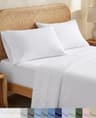
Percale is not a fabric you buy, it is a way of weaving one, and understanding that is the whole game. It is a plain weave: every thread goes over one and under the next, alternating all the way across. Because each yarn changes direction at every single crossing, the threads cannot lie flat and pack together — they are held apart, and the small gaps left between them are open channels for air. That open area is the entire reason percale sleeps cool. It is not the cotton, not the thread count, not the brand on the packet. It is the geometry of the weave, and it is the one property a hot sleeper should shop for first.
Why percale beats sateen for a hot bed
Percale and sateen are the two weaves almost all cotton bedding uses, and they behave in opposite ways. Sateen floats four threads over one to build a smooth, faintly shiny face, and those long floats let the yarns settle tightly against each other, closing the gaps that percale leaves open. Same cotton, opposite thermal behavior — the full breakdown is on percale vs sateen. If you have ever slept unusually well in a good hotel and wondered what the sheets were, the answer is nearly always crisp cotton percale.
The honest tradeoff: it feels crisp, and it wrinkles
Percale has a cool, dry, matte hand that people describe as “hotel crisp.” Plenty of hot sleepers love it and a fair number genuinely do not — if you want a sheet that feels silky and drapes heavily, percale will feel stiff and papery to you, and no brand or thread count changes that. It also wrinkles straight out of the dryer, permanently and by design; the same open, springy structure that moves air is the structure that creases. If crispness and a few wrinkles are dealbreakers, buy a smooth wicking sheet instead — lyocell or bamboo viscose, both covered on the materials page. If they are not, percale is the best-value cool sheet there is.
How to read the picks
All three of our real picks are the same weave in the same fiber — organic cotton percale — and they differ only in cloth weight, pocket depth and price. That is deliberate. Once you have the weave right, the differences between good percale sets are about durability and fit, not about how cool they sleep.
Our best overall is organic cotton percale priced low enough that you can buy two sets, which matters more than any single feature (more on that below). The deep-pockets pickis the same weave in a heavier, longer-lasting cloth with pockets cut for a mattress-plus-topper stack — buy it if you have already added height to your bed, because a standard fitted sheet will pop off a tall one at 4am. The budget pick is the cheapest way to get the correct weave when money is tight: a thinner cloth, but the mechanism that matters is fully intact.
The one to skip: microfiber pretending to be percale
The fourth pick is a warning, not a recommendation. Brushed microfiber is often sold with words like “crisp” and “cooling” that make it sound like percale, and it is the false-percale trap. Microfiber is polyester woven tight and then brushed to raise a soft nap — a fabric that neither breathes like an open weave nor absorbs sweat the way cotton does. That nap holds a layer of still air against your skin, which is the textbook definition of insulation. It can feel pleasant and dry for the first minute, then it warms up and traps everything against you. The reason a listing gets away with this is that “cooling” is not a regulated word; the physics is on do cooling sheets work. If a sheet does not say the word percale and name a natural fiber, assume it is not one.
Buy two sets before you buy a better one
The single most useful thing you can do with any cool sheet is own two of them. A sheet loaded with last night’s sweat stops behaving like the fabric you chose and starts behaving like a damp cloth, no matter how good the weave is. Two moderately priced percale sets you rotate weekly will out-perform one premium set every time, because you always start the night on a genuinely dry sheet. This is exactly why the best-overall pick is chosen for being cheap enough to double up on, not for being the most luxurious cloth in the roundup.
Match the pick to your situation
Which percale pick fits which hot sleeper.| Your situation | The pick | Why |
|---|
| First set, want the cheapest thing that works | Thread Spread organic percale | Cheapest correct weave |
| Your one upgrade, and you can stretch to two sets | Lane Linen organic percale | Cheap enough to own two |
| You added a topper or have a thick mattress | California Design Den percale | Deep pockets that stay on |
| You saw 'crisp, cooling microfiber' and nearly clicked | None of them | Microfiber is the false-percale trap |
Whichever you choose, wash it warm rather than hot, skip fabric softener — it coats the fibers and dulls the crispness you paid for — and take it out of the dryer slightly damp. Get the weave right and the rest is just looking after it.