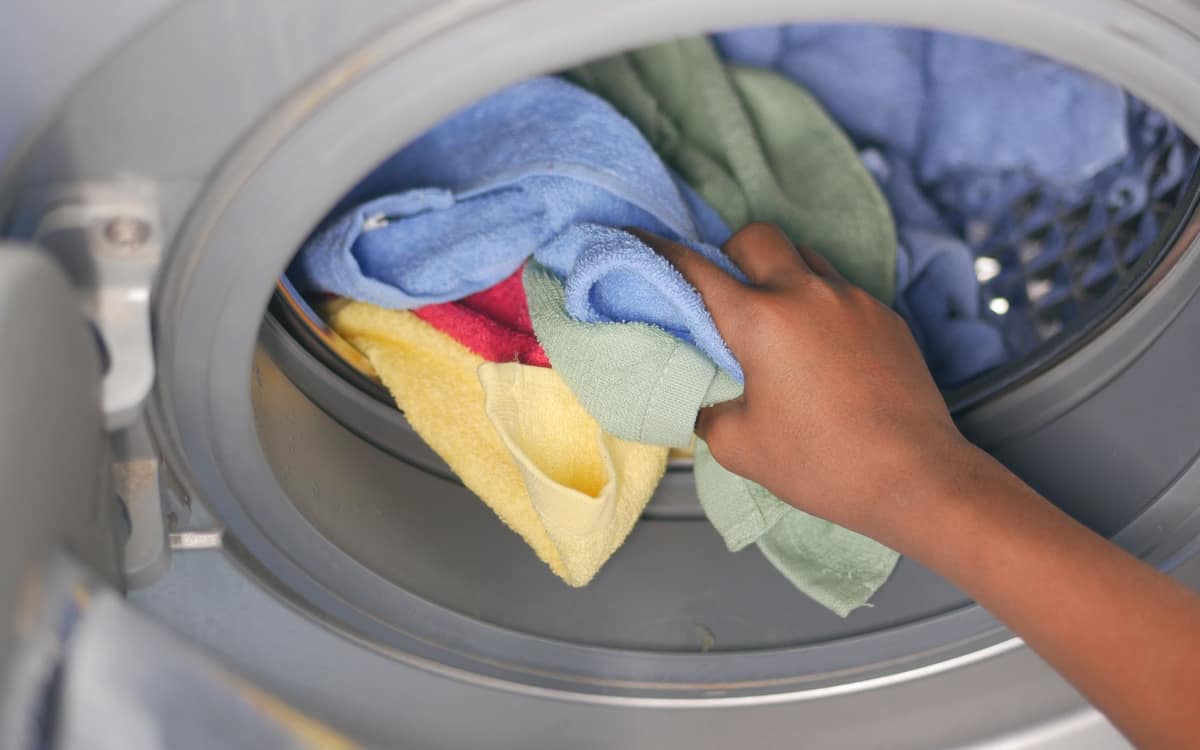
Check the weight first, then the fill.A 15 lb weighted blanket holds several pounds of water once it is soaked, and most domestic washers are rated for around 15 to 18 lb of dry laundry — which is why the standard advice is that anything over roughly 12 lb belongs in a commercial machine at a laundromat, not in yours. If it does fit: cold or warm water, gentle cycle, mild detergent, no bleach, no fabric softener, and either tumble dry low or dry flat. Glass-bead fill tolerates this; plastic pellets can warp above about 140 °F. The move that makes the whole problem go away is a washable duvet cover over the blanket, so the blanket itself needs washing two or three times a year instead of weekly.
This matters more for a hot sleeper than for anyone else, and that is not obvious. The Asthma and Allergy Foundation of America advises washing bedding weekly at 130 °F or more, because dust mites feed on shed skin and thrive when indoor humidity sits above 50% — exactly the micro-climate a sweaty bed creates. A weighted blanket is the single hardest item in your bed to launder and it sits directly on top of you all night. Those two facts collide, and the resolution is almost always a cover.
Step one: will it physically fit?
Do this before anything else, because it decides the rest. Find the dry weight on the blanket’s label and find your washer’s rated capacity in its manual or on the door frame. A blanket absorbs water as it washes, so the wet weight is substantially higher than the dry weight, and the drum has to tumble that mass without the bearings or the suspension taking the load.
The practical rule: up to about 12 lb, a standard front-loader is usually fine; 15 lb and above wants a large-capacity or commercial machine. A top-loader with a center agitator is the worst case at any weight, because the agitator drags the blanket against itself and pulls at the seams between the bead compartments. If a seam goes, glass beads end up in your drum and in your drain pump, and that is a repair rather than an inconvenience.
Step two: what is in it
Fill decides the temperature limits, and it is the one spec worth checking before you buy a weighted blanket at all.
Weighted blanket fills and how each handles laundering. Fill types as stated on the listings in our registry; shell fibers likewise.| Fill | Washing | Drying | Note |
|---|
| Glass microbeads | Machine wash cold or warm, gentle | Tumble low or air dry | Denser than pellets, so the quilt is thinner and cooler |
| Plastic poly pellets | Cold only, gentle | Air dry — heat can warp them | Bulkier for the same weight, which means more loft and more heat |
| Steel shot beads | Usually spot clean only | Air dry flat | Heavy for the volume; check the label, many are not washable |
| Sand or organic fill | Do not machine wash | Not applicable | Clumps permanently once wet; rare, and avoid |
| Minky or fleece shell | Cold, gentle, inside out | Air dry — pile mats in a hot dryer | Also the hottest shell you can sleep under |
| Cotton or viscose shell | Warm, gentle | Tumble low | What you want if you sleep hot |
Step three: the actual method
Assuming it fits and the label permits it:
Spot treat first.Most of what needs cleaning on a weighted blanket is in two or three places, and treating those directly means you can wash the whole thing less often. A mild detergent worked in with a cloth, left ten minutes, blotted out. Skip chlorine bleach entirely — it degrades the shell fiber and does nothing useful here.
Wash alone, on gentle, in cold or warm water.Alone matters: the blanket needs room to move or it balls up, and a balled weighted blanket is what throws a drum off balance. Use about half the detergent you would use for a normal load. Detergent residue is the main reason a washed blanket comes out feeling stiff and smelling faintly of nothing, and on a cooling shell it blocks the moisture handling you bought it for — the same failure we describe on when to replace your sheets.
No fabric softener, ever. Softener works by depositing a water-repellent film on the fiber. On a blanket whose job is to sit against sweaty skin, that is the exact opposite of what you want.
Run an extra rinse. A dense quilted blanket holds detergent in the batting far more than a sheet does.
Dry low, in stages, and redistribute the fill.Pull the blanket out every twenty minutes or so, lay it flat, and push the beads back out toward the edges of their compartments. Fill that dries clumped stays clumped. If the label says air dry, lay it flat over two drying racks rather than hanging it — hanging a wet weighted blanket puts the entire water weight on the top row of seams.
The fix almost nobody mentions: put a cover on it
A weighted blanket inside a washable duvet cover is a solved problem. The cover takes the sweat, the skin cells and the spills, goes in the machine weekly with the sheets, and the blanket itself drops to two or three washes a year — which means the laundromat trip stops being a monthly chore and the seams last years longer.
For a hot sleeper there is a second benefit that is arguably bigger. Most weighted blankets ship in a shell chosen for plushness rather than for heat, and minky in particular is a polyester pile that holds a thick layer of still air against you — insulation by design. Putting a cotton percale cover over it swaps the surface touching you for an open, absorbent weave without changing the weight at all. That single change does more for temperature under a weighted blanket than any “cooling” version of one. The covers worth using are on cooling duvet covers.
How often, honestly
With a cover: wash the cover weekly with your sheets, and the blanket every three to four months or when it stops smelling like nothing. Without a cover, and if you sweat: every two to four weeks, which is the real reason we keep recommending the cover.
Between washes, airing does more than people expect. An hour over a chair in a dry room lets the batting give up moisture it has been holding since the last hot night, and that moisture is what the smell actually is. The same logic applies to every layer in the bed — cooling blanket care and washing covers the rest of them.
Three things that ruin weighted blankets
Hot water on a plastic-pellet fill.Poly pellets can deform above roughly 140 °F, and deformed fill never redistributes evenly again. This is the single most common way a weighted blanket is destroyed, and it is done in one wash.
A top-loader with an agitator. The agitator pulls the quilt against itself and works the compartment seams. Front-loaders tumble; agitators wrench.
Dry cleaning. Several manufacturers explicitly prohibit it, because the solvents attack the shell coatings and the glues used in some quilted constructions. If the label says do not dry clean, that is not a liability disclaimer.
If you’re drenched most nights, or it started suddenly, that’s worth raising with a doctor — it’s outside what bedding can fix, and outside what we cover.