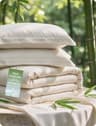
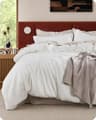
A duvet cover cannotmake a warm insert cool — warmth is loft, and the loft is inside the bag. What a cover decides is the fabric against your skin for eight hours and whether your top layer can go in the wash at all. So buy on fiber and weave: cotton percale for airflow, viscose or lyocell if you wake up damp, linen if the room is humid. The one to avoid is brushed polyester microfiber, which is the best-selling cover in the world and the worst of these for heat.
This page has to start by agreeing with the rest of the site, because the mistake it describes is the most common one in the whole category. Our blankets and comforters hub opens by telling you that buying a lighter, cooler-feeling duvet cover and leaving the same insert underneath it will not make your bed cooler. That is correct and this page does not walk it back. A 700-gram down-alternative insert inside a beautiful organic percale cover is still a 700-gram insert.
So why rank covers at all? Because two real things are decided at the cover layer, and neither of them is warmth.
The two jobs a cover actually has
One: it is the fabric touching you.This is the same argument this site makes about pillowcases, scaled up to your whole body. Your skin is not against the insert. It is against the cover, all night, over more surface area than any other single piece of bedding you own. Whether that fabric absorbs the sweat leaving your skin or leaves it sitting on the surface is a genuine, nightly difference — it just is not a warmth difference, which is why the hub is careful about the distinction.
Two: it is the layer that washes. A duvet insert is difficult to launder and a comforter is worse; both are bulky, slow to dry, and easy to ruin. The cover is the part you can strip and put through a hot wash every week. That matters more than it sounds for anyone who sweats, because a fabric loaded with old moisture and body oils stops behaving like the material you bought and starts behaving like a damp cloth. The whole reason the insert-plus-cover arrangement exists is that it makes the dirty layer washable, and choosing a cover you are willing to launder often is a real thermal decision disguised as a housekeeping one.
If your actual problem is that the bed is too warm, the fix is one layer down. That is the insert, and the picks are on the best cooling comforters and duvet inserts, with the fill-weight arithmetic on the duvet warmth guide. Come back to this page once that is sorted.
What we required before a cover could appear here
The duvet cover category is enormous and almost entirely sold on color. Every pick below had to clear all four of these.
- It states the fiber, and states it accurately.Not “premium fabric”, not “luxury blend” — the actual fiber. A listing selling bamboo-derived cloth also has to call it viscose or rayon rather than plain bamboo, because the FTC requires it and because a seller who has not read that rule has probably not read the others either.
- It states the weave or the construction. Fiber sets what the cloth can do with moisture; weave sets what it can do with air. A listing that names one and not the other has told you half the story, and most tell you neither.
- It states its finished dimensions. A cover that does not fit your insert is a cover that bunches into a lump at the foot of the bed by 3am. Every pick below publishes a size; all of them are 90 by 90 inches for queen.
- It is currently purchasable. Every product here was resolved from a live Amazon listing on the date stamped in its write-up, and prices are pulled live rather than typed in by us. The full method is on how we pick.
What we did not require was the word cooling, which appears on three of the five below and predicts nothing here. Our best overall pick never uses it at all.
The three things that decide how a cover sleeps
Rank duvet covers on these, in this order, and the category stops being about color.
One: the fiber, because it decides what happens to sweat. Cotton, linen, viscose and lyocell absorb moisture into the fiber itself and release it to the air. Polyester does not absorb; it can move liquid along its surface if it has been engineered to, and ordinary microfiber has not been. That single property is the difference between a cover that feels dry at 3am and one that feels clammy, and it is fixed at the fiber level before weave or finish get a say. The full fiber ranking is on cooling sheet materials, and it applies unchanged to covers.
Two: the weave, because it decides what happens to air.Percale is a plain one-over-one-under structure, the loosest common cotton weave, and it moves the most air. Waffle is a raised grid, so a large share of its thickness is open space. Twill and sateen are smoother and denser, which is why they drape beautifully and lie flat against you. Same fiber, genuinely different nights — the head-to-head is on percale vs sateen.
Three: the finish, because brushing undoes the other two.A brushed or napped surface lifts fiber ends to make cloth feel soft, and in doing so builds a shallow layer of still air directly against your skin. That is insulation, deliberately manufactured, on the layer where you least want it. “Double brushed” on a duvet cover listing is a warmth claim wearing a softness costume.
Not on that list: thread count, the word breathable, and the price. None of the three predicts how a cover sleeps.
How to read the picks
Our best overallis organic cotton percale — the same weave that is our standing top pick in sheets, in the shape that goes over your insert. It moves the most air of anything here, it absorbs, and it names two separate certification bodies rather than one: GOTS covers the organic fiber and its processing chain, OEKO-TEX covers the finished textile against harmful substances. Those are different claims about different things, and a listing carrying both is telling you more than a listing carrying either. Its honest limitations are that it publishes no thread count or fabric weight at all, and that it wrinkles — the seller says so itself, because the cloth is not treated with anti-wrinkle finishes. Percale is also crisp rather than silky, which some people love and some genuinely do not.
The best for night sweatspick is bamboo-derived viscose, and it is the best-documented listing we found in the entire category. It labels its fiber the way the FTC requires, states a twill weave, and prints its OEKO-TEX certificate number instead of just showing the logo — which means you can look the certificate up, and on this site that counts for a great deal. Viscose is chosen here for absorbency rather than airflow: if you wake up damp rather than merely warm, the property you want is a fiber that takes moisture into itself. The trades are real and worth stating. Viscose weakens when wet, so it wants a cold wash and a low dryer. Twill is a smooth, dense cloth that drapes flat against you, so it moves less air than the percale. And the “naturally cool to the touch” line in the listing is describing the first minute of contact rather than the night.
The best for a humid roompick is French linen, and it is the only cover on this page that publishes what its cloth weighs. A stated 170 GSM is a mid-weight linen: enough body to hang properly and survive laundering, light enough to breathe. Linen earns the humid-room slot because it does both jobs at once — it holds a large amount of moisture before it feels wet, and its structure still moves air — and in a humid bedroom, where evaporation is slow, doing both is the only thing that works. It is also the most expensive cover here by a clear margin, it arrives crisp and stiff and takes several washes to soften (the seller states this plainly), and undyed linen shifts shade between production batches, so a replacement sham may not match the one you already own.
The best without an insert pick is the one that changes what the product is. A cotton waffle cover has enough structure to work as a summer blanket on its own, which the listing states as an intended use, so on the worst nights of the year you pull the insert out and sleep under the empty cover. That is the cheapest possible hot-weather setup: you already own it, and it costs nothing to try tonight. Waffle earns its place the same way it does in our waffle blanket picks — the raised grid means much of its thickness is open air. The honest caveat runs the other way, though: used over an insert, that same texture is loft, and loft is insulation, so it is marginally warmer than the flat percale in the same situation. It also publishes no fabric weight, which matters more here than usual because the entire question is how much cloth the grid is holding.
The skipis the best-selling duvet cover shape in the world, and it comes from the same brand as two of our recommendations — which is the useful part. Brands do not sleep hot or cool; fabrics do. This one is brushed polyester microfiber: it does not absorb sweat, so moisture sits between the cloth and your skin, and the double-brushed nap that makes it feel soft is a manufactured layer of still air held against you. It is genuinely cheap, it has more corner ties than several pricier covers here, and in a cold bedroom or a guest room it is a perfectly sensible purchase. For a hot sleeper it is working against you, for the same reason set out on do microfiber sheets sleep hot.
What these listings actually publish
Published specs as the listings state them, read on the dates stamped in each write-up. Our read of published construction, not lab measurement. | Fiber | Weave | Fabric weight | Certifications stated | Price band |
|---|
| Best overall | Organic cotton | Percale | Not published | OEKO-TEX and GOTS | Mid |
| Best for night sweats | Viscose from bamboo | Twill | Not published | OEKO-TEX, number printed | Mid |
| Best for a humid room | French flax linen | Not published | 170 GSM | OEKO-TEX | Premium |
| Best without an insert | Cotton | Waffle | Not published | OEKO-TEX, number printed | Mid |
| Skip this | Brushed polyester | Not published | Not published | None stated | Budget |
One of the five publishes a fabric weight. Two print an OEKO-TEX certificate number rather than the logo alone, which is the difference between a claim and a checkable claim. And the one that names no certification and no weight is also the cheapest and the warmest — not a coincidence, and a reasonable rule of thumb when you are looking at a cover we have not reviewed.
Fit, and the things that actually ruin a cover
Every pick here is 90 by 90 inches for queen, and the ones that state a sham size give 20 by 26 inches — the common US queen sizing. But inserts are not standardized, and a 90-inch cover over an 88-inch insert is fine while a 90-inch cover over a 96-inch insert is a wrestling match. Measure the insert you already own before ordering, because the cover is the piece that has to accommodate it.
Two features decide whether you keep using a cover or quietly stop. Corner ties are loops sewn into the cover's inside corners that you knot to the loops on the insert; without them the insert migrates into a wad at one end within a week, and a wadded insert is both lumpy and unevenly warm. Closureis the other: a hidden zipper is faster and more secure than buttons, and buttons are the reason a corner works its way open in the night. Three of the five picks here state a closure type and only two state corner ties — and the one that describes both most clearly is the one we are telling you not to buy, which is a fair reminder that build details and fabric quality are separate questions.
One more practical note that costs nothing. Wash a new cover before first use. Every natural fiber on this page — cotton, linen, viscose — performs better after a wash than out of the bag, because manufacturing finishes and sizing agents come off in the first cycle, and those finishes sit on exactly the surface that is supposed to be absorbing your sweat. It is the same reason we tell people to skip fabric softener permanently: it works by depositing a hydrophobic coating on the fiber, which undoes the property you paid for. The laundering rules are on care and washing.
If the bed is still too warm after this
Then the cover was not your problem, and this page has done its job by being clear about that in advance. Work in this order: take the insert out entirely for a couple of nights and see what the bed feels like under the cover alone; if that is comfortable, your insert is over-lofted for your room and a lighter one is the fix. If it is still too warm with no insert at all, the heat is coming from below rather than above, and the next layer to look at is the mattress surface rather than the top of the bed — the reasoning is on what to fix first.
And if you and the person next to you disagree about all of this, stop sharing a top layer. Two single duvets on one bed — the Scandinavian arrangement — solves the mismatched-couple problem outright and costs less than most of the engineering people try instead. It is covered on cooling bedding for couples.
One sizing note that applies to every cover on this page. All four publish the same 90 by 90 inches for queen, while comforters sold as queen run anywhere from 88 by 88 to 88 by 92 — so an insert two inches too long for its cover is an easy and common mistake. The sizes we read off live listings are on comforter and duvet sizes.