Skip to content
Chill & Chamber

Cooling Mattress Toppers

How to stop a mattress topper sliding around

Add three inches to the bed and your old fitted sheet no longer reaches. Almost every sliding topper is that one spec, and the fix costs less than the topper did.

By Stephen V. · Specs last verified · Prices live as of October 25, 2026

We earn a commission if you buy through our links, at no extra cost to you. It never changes what we rank or what we say — how this is funded and how we pick.

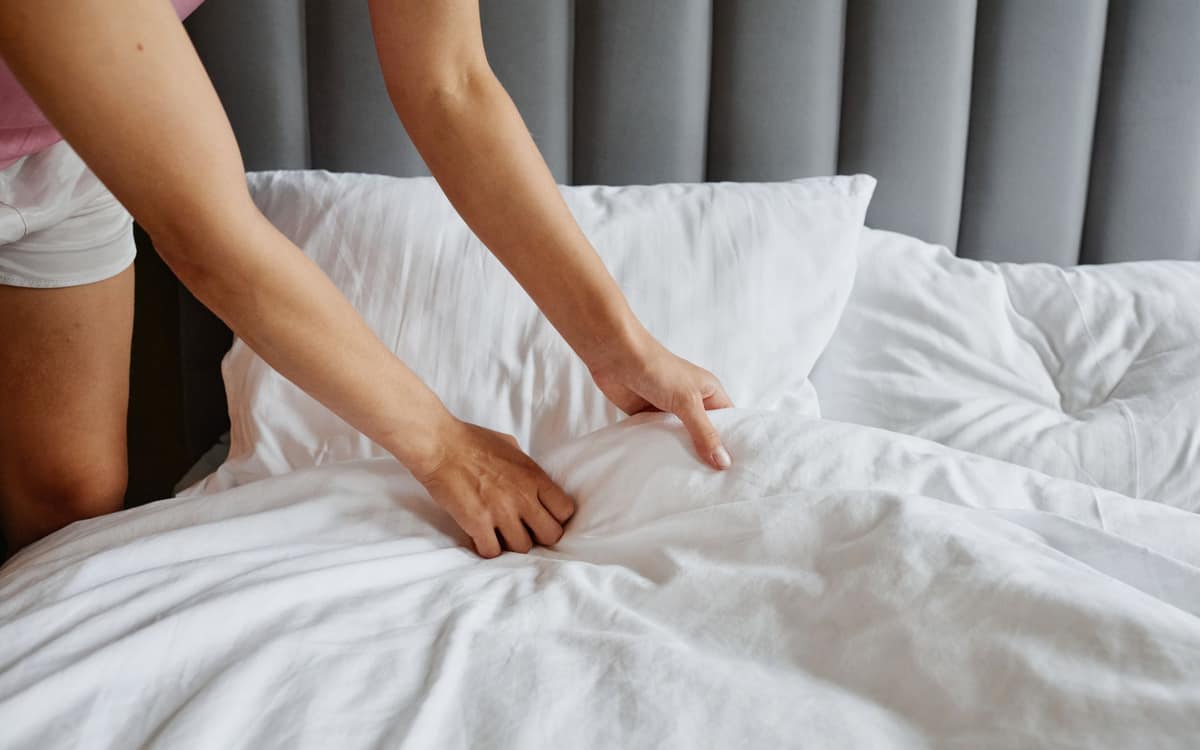
Hands smoothing white sheets flat across a bed

Measure your mattress, add your topper’s thickness, and buy a fitted sheet whose published pocket depth exceeds that total. In almost every case that is the entire fix: a topper slides because nothing is clamping it and the one thing that could — sheet tension — ran out of fabric when you added three inches to the bed. If a deep-pocket sheet is not enough, add a fitted layer over the topper rather than under it, and check whether a slippery waterproof protector underneath is the thing it is sliding on. Avoid tape and adhesives; they damage the mattress cover and fail within weeks anyway.

This is the most predictable complaint in the category and the least discussed before purchase. Nobody buys a topper thinking about their sheets. Then the topper arrives, it is three inches thick, and on the second night a corner of the fitted sheet lets go and the whole stack walks toward the foot of the bed.

Why a topper slides at all

There is nothing holding it. A mattress topper sits loose on top of the mattress, and the only forces acting on it are your weight pressing down, friction between two smooth surfaces, and whatever tension a fitted sheet manages to apply over the top.

Friction between foam and a knitted mattress cover is low, and it gets lower when either surface is slippery — which is exactly what happens if you put the topper on top of a waterproof protector, because the face of a protector is usually a smooth synthetic over a film. Your movement at night is lateral as much as it is vertical: you roll, you push off with a knee, you drag the whole stack a few millimetres at a time. Do that two hundred times a night for a week and the topper has visibly migrated.

So the sheet is doing all the work, and the sheet is where the problem usually is.

Do the arithmetic before you buy anything

Measure the mattress from the base seam to the top surface, ignoring any pillow top compression. Add the stated thickness of the topper. That total is the number your fitted sheet has to clear, and it is almost always larger than people expect.

Here is why it bites. The mattresses in our own registry publish heights of 10 to 14 inches — two 12-inch hybrids, a 14-inch euro-top hybrid and two 10-inch foam beds. Add a three-inch topper to the 14-inch bed and you need a sheet that reaches 17 inches. Now look at the published depth limits across the fitted products we rank:

Published fit depths on fitted products in our registry, read from each listing. Where a product does not state a depth we have left it out rather than estimating — which is itself the point of the table.
ProductTypePublished depth it fits
Linenspa waterproof protectorFitted protector8 to 14 inches
Cozy Bliss leakproof padFitted protector8 to 18 inches
Stylinen organic lyocell sheet setFitted sheet16 inches stated
PlushDeluxe bamboo protectorFitted protectorUp to 18 inches
California Design Den percale setFitted sheetDeep pockets; no figure published

A 14-inch mattress with a three-inch topper is outside the Linenspa protector’s stated range entirely and right at the edge of the 16-inch sheet. That is not a product defect; it is arithmetic nobody performed. And notice the last row: “deep pockets” is a marketing phrase, not a measurement, and most sheet listings in this category never commit to a number. When one does, that is worth paying for — which is the reason the lyocell set in our picks is there.

More on which cooling sheets actually publish a depth is on deep-pocket cooling sheets, and topper sizing in general is on topper sizes and fit.

Fix one: the deep-pocket fitted sheet

This is the right answer for most people and the cheapest one. A fitted sheet with enough depth pulls its elastic hem under the mattress lip on all four sides, and once that hem is seated the sheet is clamping the topper to the mattress across the whole surface. A sheet that only just reaches does the opposite: the elastic sits on the vertical face of the mattress rather than under it, every roll you make lifts a corner, and once one corner is off the rest goes quickly.

Buy percale or lyocell rather than a stretchy jersey if you have the choice. A woven sheet holds tension; a knit stretches to accommodate the movement you are trying to prevent. The percale set in our picks is the same weave as our overall sheet pick in a heavier cloth with deeper pockets, which is exactly the combination you want once the bed has grown.

Fix two: a fitted layer over the topper

If a deep sheet is not enough — genuinely thick toppers on tall mattresses do defeat it — the next move is a second fitted layer between the topper and the sheet. A quilted fitted pad or a fitted protector has its own elasticated skirt, so it grips the mattress independently and sandwiches the topper rather than relying on the sheet to do everything.

Two cautions. Put it overthe topper, not under it: a smooth protector face under a foam topper is a bearing surface and makes the sliding worse, which is a mistake we see described constantly as “the topper slides no matter what I do”. And remember what each layer costs you thermally. A quilted pad is thin and barely insulates. A waterproof protector blocks some vapor by definition, and adding one you do not otherwise need is insulation acquired for nothing. If you are adding this layer purely to stop movement, the quilted pad is the lighter choice; if you also need waterproofing, the deep-fitting viscose-faced protector in our picks is the one that costs you the least breathability.

Fix three: change the friction, not the clamping

Worth knowing in order of how well it works.

Take the slippery layer out from underneath. Free, and the single most overlooked fix. If there is a protector or an old mattress pad under the topper, move it above the topper. Foam directly against a knitted mattress cover has noticeably more grip than foam against a laminated face.

Non-slip rug underlay. A sheet of open-weave rubberised matting between the mattress and the topper does work, and it is the only cheap friction fix we would recommend. Use the open-mesh kind rather than a solid rubber sheet: the mesh adds grip without becoming a vapor barrier in the middle of your bed, and a solid rubber layer under a hot sleeper is a bad idea for obvious reasons.

Sheet suspenders or elastic corner straps. These help a sheet stay seated rather than holding the topper directly. They are a reasonable supplement to a correctly sized sheet and no substitute for one.

Tape, glue and adhesive strips. Do not. They peel the knitted mattress cover when removed, they can void a mattress warranty, and they let go within weeks once body heat has softened the adhesive.

Check that it is not the fit or the base

Two causes that no sheet will fix. First, a topper that is the wrong size: a queen topper on a king mattress has four inches of free play before anything is even tensioned, and a topper slightly larger than the mattress will buckle at the edges and then creep. Second, the base. A mattress that itself shifts on a slatted frame or a too-small bed frame takes the whole stack with it, and you will keep re-fixing the topper for a problem one level down. The base is also where airflow under the bed comes from, which is covered on the bed base and airflow.

Finally, a topper that has started sliding after years of staying put is often a topper that has lost its shape rather than its grip — a dished slab has less contact area and more room to move. The condition tests are on how long a mattress topper lasts.
Quick picks

Ranked on published construction and buyer fit. Select a row to jump to the full write-up. We have not slept on any of these — here is exactly what we do instead.

#ProductBest forHow it coolsPrice
1
California Design Den Organic Cotton Percale Sheet Set, Deep Pockets

California Design Den Organic Cotton Percale Sheet Set, Deep Pockets

Deep mattresses, or a mattress plus a topper

The fix most people needAirflow (open structure)
$59.99 · View on Amazon

Price as of October 25, 2026. #ad How we’re funded

2
PlushDeluxe Bamboo Waterproof Mattress Protector

PlushDeluxe Bamboo Waterproof Mattress Protector

Deep mattresses, and beds that already have a topper on them

Deepest fitted layer we rankMoisture wicking
$37.99 · View on Amazon

Price as of October 25, 2026. #ad How we’re funded

3
Stylinen 100% Organic Eucalyptus Tencel Lyocell Sheet Set, 4-Piece

Stylinen 100% Organic Eucalyptus Tencel Lyocell Sheet Set, 4-Piece

Deep mattresses, and anyone who wants the spec written down

Best sheet that publishes its depthMoisture wicking
$79.99 · View on Amazon

Price as of October 25, 2026. #ad How we’re funded

4
MATBEBY Quilted Fitted Mattress Pad and Protector

MATBEBY Quilted Fitted Mattress Pad and Protector

A washable layer on a bed you already like

Cheapest way to pin one downLess insulation
$26.58 · View on Amazon

$31.9917% off

Price as of October 25, 2026. #ad How we’re funded

#1The fix most people need

California Design Den Organic Cotton Percale Sheet Set, Deep Pockets

The same weave as our top pick in a heavier, longer-lasting cloth, with pockets deep enough for a topper. Buy this one if you have already added height to the bed.

What it gets right

  • Deep pockets — the failure mode once you add a 3-inch topper is a fitted sheet that pops off at 4am
  • Organic cotton, percale weave
  • Substantial hand-feel that survives repeated hot washes

Trade-offs

  • Costs more than the LANE LINEN set for the same fundamental weave
  • Heavier cloth takes longer to dry
  • Listing does not publish GSM
Published specifications
Material100% organic cotton
How it cools (our read)Airflow (open structure)
WeavePercale
Thread countNot published
Fabric weight (GSM)Not published
Certifications statedNone stated

Why the construction matters. Deep-pocket construction is the spec most people discover they needed only after buying a topper. Check your mattress height plus topper height before ordering any fitted sheet.

Specifications read from the product listing on July 23, 2026. “Not published” means the listing does not state that figure.

#2Deepest fitted layer we rank

PlushDeluxe Bamboo Waterproof Mattress Protector

A viscose face on a membrane, fitted to 18 inches — the deep-bed answer. You pay roughly half again what the plain options cost for a surface that moves sweat instead of holding it.

What it gets right

  • Viscose derived from bamboo on the sleeping surface, which absorbs and spreads moisture rather than leaving it on your skin
  • The listing states a fit up to 18 inches deep — the deepest of the fitted picks here
  • Explicitly noiseless: no crinkle layer, which is the usual price of waterproofing

Trade-offs

  • No fabric weight published, so you cannot compare the cloth against the one protector here that does state a GSM
  • 'Regulates heat' is the listing's phrasing, not a measurement — a membrane still slows vapor whatever the face is made of
  • Costs more than twice the cheapest protector on this page for a difference you feel rather than measure
Published specifications
MaterialViscose derived from bamboo face, waterproof membrane backing
How it cools (our read)Moisture wicking
Fabric weight (GSM)Not published
Certifications statedNone stated

Why the construction matters. The face fabric is the only part of a waterproof protector you can change the physics of. The membrane behind it will slow vapor either way; a face that pulls moisture sideways gives that vapor somewhere to go before it reaches the film.

Specifications read from the product listing on August 31, 2026. “Not published” means the listing does not state that figure.

#3Best sheet that publishes its depth

Stylinen 100% Organic Eucalyptus Tencel Lyocell Sheet Set, 4-Piece

The only lyocell set here that publishes its pocket depth, which for a fabric this slippery is the spec most likely to send it back. Buy it for the stated 16 inches, not for the word organic.

What it gets right

  • Deep pockets stated at 16 inches — the one fit spec that matters
  • 4-piece set: fitted, flat and two pillowcases
  • Names the fiber as Tencel lyocell rather than generic eucalyptus

Trade-offs

  • Says organic without naming a certifying standard
  • No weave, thread count or fabric weight published
  • Mid-band price for a listing that is still mostly unspecified
Published specifications
Material100% organic eucalyptus Tencel lyocell
How it cools (our read)Moisture wicking
WeaveNot published
Thread countNot published
Fabric weight (GSM)Not published
Certifications statedNone stated

Why the construction matters. The listing claims organic but names no certifying body. We record certifications only where the listing names the standard, so this one is empty on purpose — the claim is the seller's, not a verified mark.

Specifications read from the product listing on August 31, 2026. “Not published” means the listing does not state that figure.

#4Cheapest way to pin one down

MATBEBY Quilted Fitted Mattress Pad and Protector

A cheap quilted pad that adds a thin comfort layer and takes the wash instead of your mattress. Modest on cooling, useful on laundry.

What it gets right

  • Thin enough not to insulate meaningfully
  • Machine washable, which matters if you sweat
  • Very cheap

Trade-offs

  • The cooling claim is generic — no named fiber technology behind it
  • Thin fill offers little cushioning
  • No fill weight or fabric weight published
Published specifications
MaterialPolyester fill, polyester face
How it cools (our read)Less insulation
Certifications statedNone stated

Why the construction matters. Being washable is an underrated thermal feature. Sweat-loaded fabric holds moisture against you; a layer you can strip and wash weekly stays closer to its original behavior.

Specifications read from the product listing on July 23, 2026. “Not published” means the listing does not state that figure.

Common questions

How do you stop a mattress topper from sliding?

Buy a fitted sheet whose published pocket depth exceeds your mattress height plus the topper's thickness. Sheet tension is the only thing clamping a topper down, and when the sheet only just reaches, the elastic sits on the side of the mattress instead of under it and lifts off every time you roll. If that is not enough, add a fitted quilted pad or protector over the topper so it has its own skirt gripping the mattress.

What depth sheet do I need with a mattress topper?

Measure the mattress from base seam to top surface, add the topper's stated thickness, and buy above that total. The mattresses in our registry publish 10 to 14 inches, so a 14-inch bed with a three-inch topper needs a sheet reaching 17 inches — which is outside the stated range of some fitted protectors and right at the limit of a 16-inch sheet. Treat 'deep pockets' with no number as unverified.

Should a mattress protector go under or over a mattress topper?

Over it, in almost every case. A protector face is usually a smooth synthetic over a film, which is a low-friction bearing surface — putting it under a foam topper makes the sliding worse, and this is the most common reason people conclude that nothing works. Above the topper, its elasticated skirt grips the mattress and helps hold the topper down.

Does non-slip rug underlay work under a mattress topper?

Yes, and it is the only cheap friction fix we would recommend. Use the open-mesh rubberised kind rather than a solid rubber sheet: the mesh adds grip without becoming a vapor barrier in the middle of the bed. A solid rubber layer under a hot sleeper traps both heat and moisture, which defeats the point of the topper.

Can I tape or glue a mattress topper down?

Don't. Adhesive strips peel the knitted mattress cover when they come off, they can void a mattress warranty, and they let go within weeks once body heat softens the adhesive. Every genuine fix here works by clamping — sheet tension, a fitted skirt, or friction — rather than by sticking.

Why does my topper slide even with a deep-pocket sheet?

Check three things in order. Is there a slippery protector or old pad underneath it, which should be moved above the topper? Is the topper the right size for the mattress, since a queen topper on a king has inches of free play before anything is tensioned? And does the mattress itself shift on its base, which takes the whole stack with it? A dished, worn topper also moves more than a sound one, because it has less contact area.

Will adding layers to hold the topper down make me sleep hotter?

Some will. A thin quilted fitted pad barely insulates and is the light choice if movement is the only problem. A waterproof protector blocks some water vapor by definition, so adding one you do not otherwise need is insulation acquired for nothing. The deep-pocket sheet is the fix that costs you no breathability at all, which is why it is first on this page.

Sources

Try the cheap thing first

Work down this list in order. Each step costs more than the one above it, and most people stop before the bottom. Replacing a mattress to fix a problem your sheets were causing is the most expensive mistake in this category.

  1. 1Pillowcase, then pillowUnder $20 to start
  2. 2Sheets$25-$60
  3. 3Top layer$30-$90
  4. 4Topper or pad$30-$300
  5. 5The mattress$200-$900

Before any of it: work out which one is actually your problem. If your bedroom is 78°F, none of these will save you.