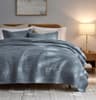
Buy a quilt whose shell is 100% cotton and whose stitching runs in close channels, not wide boxes. Those two things decide almost everything. Our pick is the palassio cotton channel quilt, which is all-cotton front and back with continuous channel stitching that physically prevents the fill from lofting. If your nights are hotter than that, skip quilting altogether and sleep under the Bedsure four-layer cotton muslin— no fill, no batting, no loft, just four layers of open gauze. Avoid anything sold on a Q-Max number: that measures the first thirty seconds of contact, not the night.
Why a quilt is cooler than a comforter, in one number
The bedding industry has a standard way of measuring how warm a fill is, and it is not a temperature. It is a volume. The International Down and Feather Testing Laboratory describes its fill power test as one that “determines the volume of fill material per one ounce (USA) or 30g (Europe/Japan/IDFB)” — material is conditioned for 72 hours and then measured in a cylinder to see how much space it occupies.
That is the whole argument on this page. The trade’s warmth metric for a fill is how much air a fixed weight of it can hold open. Insulation in bedding is not the fiber; it is the still air the fiber traps. Down is warm because it lofts enormously for its weight, not because feathers are special.
Now consider what a quilt is. A quilt is a sandwich — face fabric, thin batt, back fabric — sewn through all three layers at close intervals. Every stitch line crushes the fill to zero thickness, and the lines are close enough together that the batt cannot loft meaningfully anywhere between them. A comforter does the opposite: it is box-stitched or baffled specifically so the fill can puff up into chambers. Same fiber, same weight, opposite construction, opposite thermal result.
This is why “lightweight comforter” and “quilt” are not interchangeable even when a listing uses both words in the same title. A lightweight comforter has less fill in a lofting structure. A quilt has fill in a structure that refuses to loft. For a hot sleeper the second one is the better machine. We separate the whole family on comforter versus duvet versus quilt.
What we required before a quilt went on this page
We have not laundered, weighed or slept under any of these. What we can do is read what each listing publishes and rank on construction. Here is the filter in the order we applied it.
1. The shell fiber, and it has to say 100%.This is where the quilt aisle does most of its damage. The default fabric for a cheap quilt is brushed polyester microfiber, because it photographs beautifully, costs almost nothing and feels soft in a shop. It is also hydrophobic: it does not absorb sweat, so moisture stays on your skin as a film and you wake up damp rather than dry. Cotton takes that moisture into the fiber. If a listing says “ultra-soft microfiber” and not a fiber percentage, assume polyester. Three of the five pieces here state 100% cotton outright. The same fiber-marketing trap runs through the sheet aisle, where a prestigious fiber name gets woven into the warmest possible fabric — are Egyptian cotton sheets good for hot sleepers?
2. The stitching pattern.Channel stitching — long parallel lines a few inches apart — is the coolest common pattern, because it leaves no large unstitched area for the fill to rise in. Pick-stitch and tight ultrasonic patterns behave similarly. Wide diamonds and big squares are warmer than they look. Baffled construction, where fabric walls hold the chambers open, is the warmest of all and is a comforter feature rather than a quilt one.
3. How little is between you and the room. Taken seriously, this criterion eventually argues itself out of quilts altogether, which is why a four-layer cotton gauze blanket with no fill at all is the second pick on a page about quilts. If the goal is the least possible insulation while still being covered, layered gauze beats any quilted construction, and we would rather say so than keep you inside the category.
4. Whether the fill is published at all.It usually is not, and that is worth stating plainly: four of the five listings here name the shell fiber and say nothing about what is inside. Our product tables show “Not published” rather than a guess, because the absence is a real finding about how this category is sold.
5. Washing reality. A quilt that survives a weekly wash is worth more to a sweating sleeper than one that is marginally cooler on paper. Thin, all-cotton, machine-washable and able to dry in a single cycle is the practical spec, and it rules out most of the heavy decorative bedspreads this search term also returns.
Why we did not rank on Q-Max
A growing share of “cooling” quilts and blankets lead with a Q-Max figure — 0.4, 0.45, 0.5 — and it is a real measurement of a real property. It is also the wrong property for something you lie under for eight hours.
Q-Max measures the peak rate at which heat leaves your skin in the instant you first touch a fabric. A high number means a cold, almost wet-feeling first contact. That sensation ends as soon as the fabric reaches your skin temperature, which takes a couple of minutes, and what you are left with is whatever that fabric does thermally for the rest of the night. The fabrics that score highest on Q-Max are smooth, dense, flat-filament synthetics — precisely the construction that goes clammy once warm. We take the number seriously enough to have written a whole page about what it does and does not tell you: Q-Max cooling ratings explained. That is why the cheapest piece here, which is also the only one with a Q-Max claim, is the one we tell you to skip.
The picks
Five pieces, each resolved live through the Amazon Creators API on 3 November 2026 with availability confirmed before it went on the page. Prices come from our live price layer rather than from our memory, and the price language in prose is relative to this list.
Quilt, gauze blanket, or waffle weave?
These three are the serious options for the top layer of a hot sleeper’s bed, and they fail in different directions.
A quilt is the most normal-looking answer. It has a little fill, so it has a little warmth and a little weight, which most people want in a bedroom that drops a few degrees overnight. It also tailors a bed visually in a way a plain blanket does not. Buy a quilt if you want one piece on the bed year-round.
Layered cotton gauze is the coolest. There is no fill, so there is nothing to trap air, and the open weave lets moisture out as vapor instead of holding it. The trade is that it is genuinely thin: in a cold snap it is not enough, and it looks rumpled rather than smart. Buy gauze if your problem is severe and your room is warm.
A cotton waffle weave sits between them. The waffle structure holds pockets of air that are open at the surface rather than sealed inside a batt, so it has body without the insulation penalty of a lofted fill. Our waffle blanket roundup covers those separately. If you like the look of a waffle throw, it is a very good compromise.
What all three have in common is that they are a single, thin layer you can remove in one motion. That matters more than the thermal spec if you get night sweats, because the defining feature of an episode is that it arrives suddenly and passes. A bed built as one warm layer gives you a binary choice at 3am; a bed built from thin layers lets you shed one and keep sleeping. The full layering argument is on cooling blankets for night sweats.
Sizing: buy the coverlet size, not the bedspread size
“Quilt”, “coverlet” and “bedspread” describe three different amounts of fabric, and the words are used loosely in listings. A coverlet covers the mattress and tucks under or just past the sides. A bedspread drops to the floor and covers the pillows, which means significantly more fabric around you and over the edges of the bed. For a hot sleeper the coverlet dimension is the right one: less material, and it does not seal the sides of the mattress the way a floor-length spread does.
A queen piece sold at roughly 90 x 90 inches is a coverlet. The same nominal size at 102 x 118 is a bedspread. Check the inches rather than the word, and remember that a tall mattress plus a topper eats several inches of drop. Our comforter and blanket size guide has the measurements for every bed size.
What we could not tell you
Four of these five listings do not publish the fill fiber, and none publishes a fill weight or a fabric GSM. Those are the figures that would let anyone rank quilts thermally with real confidence rather than by construction logic, and they are simply not in the data. Where our tables say “Not published”, that is what the listing says.
We also looked for a published measurement showing how much a given quilting density reduces a batt’s effective loft, and did not find one we could read and cite. The mechanism is not in doubt — a stitch through a batt compresses it at that point, and the industry’s own fill metric is a volume — but we are not going to put a percentage on it that we cannot source.
Where a quilt sits in the order of fixes
Changing your top layer is a cheap, fast, high-value experiment, and it is one step below the sheets in our ladder. If you are starting from a lofted comforter, moving to a quilt or a gauze blanket is one of the largest single changes available to you for well under a hundred dollars — larger than most mattress toppers and vastly cheaper than a bed.
Do the sheets first if they are polyester, because the layer touching your skin outranks the layer above it: cooling sheet materials. Then the top layer. Then, if you are still hot, work down into the mattress. The full cheapest-first sequence is on what to fix first, and the whole-bed version is on the complete cooling bed setup.