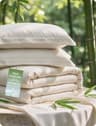
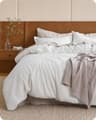
For night sweats, the best top layer is a light, absorbent one you can throw off and pull back without properly waking: a cotton waffle blanket, or two thin layers in place of one comforter. If you keep a duvet, give it an absorbent viscose or linen cover. Skip cold-touch nylon blankets and weighted blankets.
Once you are in bed, everything underneath you is fixed until morning; changing a sheet means getting up and stripping the bed. The top layer is the exception. It is the only part of the bed you can change from inside it — push it down, pull it back, or swap it for a dry one — in the time it takes to half-wake. For someone who wakes up soaked, that makes it the layer most worth getting right, and the one most often gotten wrong, because the usual answer is a single thick comforter with exactly two settings: on, or off.
For night sweats that come with menopause, the National Institute on Aging describes the pattern plainly. Night sweats are hot flashes that happen at night; a hot flash is a sudden feeling of heat; and heavy sweating and cold shivering can follow. Most hot flashes last between 30 seconds and 10 minutes. That asks a top layer to do two opposite jobs within minutes — come off fast, then go back on over skin that is now damp — and it is why the institute’s own advice includes layering your bedding so it can be adjusted as needed. Not every night sweat follows that pattern, but the demand on the top layer is the same whenever a night swings from too hot to damp and cold.
This page is only about that top layer, product by product. The wider routine — absorbent sheets, a protector, two sets of everything — is on bedding for menopause night sweats, and whether your bed or your body is behind the sweating is on night sweats: causes and what bedding can fix.
If you’re drenched most nights, or it started suddenly, that’s worth raising with a doctor — it’s outside what bedding can fix, and outside what we cover.
What we required before a product could appear here
The top-layer shelf is mostly comforters with the word cooling in the title. Every pick below had to clear all four of these first.
- The surface that touches you absorbs. The listing names the fiber, and it is cotton, linen or viscose rather than nylon or polyester. Sweat that a fabric cannot take in stays between the fabric and your skin, which is the feeling you are trying to get rid of. The one exception below is the skip, included because its listing offers it for exactly this problem.
- It adds little loft of its own. Either it is a blanket with no fill at all, or it is a cover, which adds a layer of cloth and nothing else. Warmth is loft, as the duvet warmth guide sets out, and loft is the one thing you cannot adjust halfway through a sweat.
- It washes at home. A top layer on a sweating sleeper’s bed is laundered far more often than average, and a layer that is a struggle to wash is a layer that stays on the bed damp.
- It is currently purchasable. Every product here was resolved from a live Amazon listing on the date stamped in its write-up, and prices are pulled live rather than typed in by us. The full method is on how we pick.
That first test is why there is no finished comforter on this page. None of the comforters or duvet inserts we currently track names an absorbent fiber for its outer fabric; they lean on cooling shells, cold-touch faces and polyester instead. If you want to keep a duvet, the answer below is to keep the insert light and change what goes around it.
The four things that decide how a top layer handles a night sweat
Rank anything you might put on top of you on these, in this order.
One: loft, because it sets how hot you get before you sweat. A comforter keeps you warm by holding still air against you, and the thicker it lofts, the more it holds. Fabric does not change that. For a night sweat the right amount of loft is usually less than you think, because you can always add a second thin layer and you cannot subtract half a comforter. Pile surfaces count as loft too: minky, fleece and sherpa are made to hold air against your skin.
Two: the fiber against your skin, because it decides where the sweat goes. Cotton, linen and viscose take moisture into the fiber. Nylon and ordinary polyester do not, so the sweat sits on the surface. This is where the cooling-blanket category goes wrong for this problem: a cold-touch face is usually nylon, it feels cold until it reaches your skin temperature, which takes minutes, and after that it is a non-absorbent synthetic lying on damp skin. Why the cold fades is on how cooling blankets work.
Three: whether it comes off and goes back in one move. Picture the actual motion at 3am: one arm pushing a layer down to your waist, and ten minutes later the same arm pulling it back up. A thin blanket does that easily. A thick comforter tends to end up in a heap you have to wrestle back. Two thin layers do it best, because you can shed the top one and keep the one underneath, which gives you a middle setting a single comforter does not have.
Four: how it washes. You will wash the top layer far more often than someone who does not sweat. Cotton is the easy fiber; viscose is weaker wet and wants a cold wash and a low dryer. Skip fabric softener on all of them, for the reason given on washing a cooling blanket: it coats the fiber and cuts the absorbency you chose it for.
Not on that list: the word cooling, a Q-Max number, or the price.
If you want to keep your comforter
In a cool room that is a reasonable choice, and three changes make it behave. If the insert is winter-weight, the problem is loft, and a lighter insert is the fix; the ranked options are on the best cooling comforters and duvet inserts. Put it in an absorbent cover, because the cover is the part that touches you and the part that goes in the wash every week. Then add a waffle blanket underneath, so that when the heat arrives you push the duvet off and keep the blanket. That is the two-thin-layers idea, built from a duvet you already own.
Weighted and heavy blankets
People with night sweats often ask about weighted blankets and heavy blankets, and the honest answer to both is the same: weight works against every factor above. A weighted blanket presses cloth flat against you and closes the gap air would otherwise move through, it is hard to push off when you are half-asleep, and the default cover is often minky, a polyester pile. If you rely on one, the ways to make it sleep cooler — glass-bead fill, a cotton cover, a lighter weight — are on weighted blankets and heat. On the nights you sweat, the simplest option is to leave it off the bed and use a waffle blanket instead.
Cooling blankets for hot flashes
A search for a cooling blanket for hot flashes usually ends at a cold-touch blanket, which is the wrong tool here even though a cold-touch pillowcase can be a reasonable one. A pillowcase is a small surface you can turn over in a second, onto an absorbent reverse. A blanket covers your whole body and stays on through the sweat and any chill after it, so a few minutes of cold are followed by hours of a fabric that does not absorb. If you want a cold surface when a hot flash starts, put it under your head rather than over your body; the flip-side case is on our pillows for night sweats page.
How to read the picks
Our best overall is a 100% cotton waffle blanket, and it wins by being the simplest thing that clears every test above. It has no fill, the waffle grid holds much of the cloth off your skin (the structure is explained on the best waffle blankets), the fiber is stated as one thing, cotton, and it goes down to your waist and back up with one arm. The listing we read on September 17, 2026 says it can be tumble dried or hung to dry, and it is the cheapest product we recommend here — cheap enough to buy two and keep the second folded at the foot of the bed, so a damp blanket is swapped for a dry one without getting up. Its limitations: cotton can feel heavy once it is genuinely soaked, so if you drench the blanket rather than dampen it, the spare matters more. It publishes no fabric weight. And the listing’s promise of warmth in winter and cool in summer is an all-season line we would not lean on; alone, it is a warm-weather layer.
The best if you keep your duvet pick is a duvet cover in 100% viscose derived from bamboo, labeled that way rather than as plain bamboo, in line with the FTC’s guidance that such fabric be named as rayon. The listing read on September 17, 2026 prints its OEKO-TEX certificate number, 21.HCN.83393, so the certification can be looked up, and states a twill weave. The case for it is simple: under a duvet, the cover is the only part that touches you, viscose takes sweat into the fiber, and a cover can be stripped and washed weekly where a finished comforter rarely can. The trades: twill is a smooth, dense cloth that drapes flat against you, so it moves less air than a waffle. Viscose weakens when wet, and the listing asks for a cold wash below 104°F and a low dryer. Its “naturally cool to the touch” line describes the first minute, not the night. And no cover reduces the loft of what is inside it, so this only works over an insert light enough for your room.
The best cover to sleep under empty is a 100% cotton waffle duvet cover, for people who want the bed to look like a duvet without sleeping under one. Its listing, read on September 17, 2026, suggests using it alone as a breathable blanket in spring and summer and adding an insert in cooler weather. Empty, it is a waffle layer the shape of a duvet that goes in the machine as easily as a sheet, and it prints an OEKO-TEX certificate number too, 18.HPK.48415. Against it: it sits a price band above the waffle blanket for much the same job, and it publishes no fabric weight, the one figure that would say how warm it is empty. The bigger caveat is the insert. Put one back in and you are under a single lofted layer again, which is what this page is trying to get you out of; on the nights you sweat, use it empty.
The best for a humid bedroom pick is a French linen duvet cover, and it is the only product here that publishes what its cloth weighs: 170 GSM, stated again on the listing we read on September 17, 2026. Linen is for the room where evaporation is slow. It holds a lot of moisture before it feels wet, and its stiff fiber holds the cloth off your skin, so it keeps doing both jobs when the air is too damp for sweat to leave quickly; why humidity changes the problem is on humidity and sleeping hot. It states OEKO-TEX Standard 100, a hidden zipper and corner ties. It is also the most expensive product here by a wide margin, it arrives crisp and softens only with washing, and undyed linen can vary in shade between batches. Ignore one line in its listing: that linen does not need frequent washing. On a bed where someone sweats most nights, it does.
The skip is a cold-touch cooling blanket, and it is here because its own listing, read on September 17, 2026, offers it for exactly this problem: it says a cool blanket can be a great help for night sweats and will keep you cool and dry all night. It does publish a Q-Max figure, and the cold on first contact is real. The rest is beyond what the material can do. Q-Max describes the first moments of contact; once the face reaches your skin temperature the cold is gone, and a passive blanket has nowhere to send the heat. The face is nylon, which does not absorb, so it cannot keep you dry. The listing also argues that its dense weave keeps it cool for longer; a denser cloth may take a little longer to warm, but it still gets there. It is the cheapest thing on this page and pleasant on a warm night with no sweating. For night sweats it is the wrong fiber doing the wrong job.
What these listings actually publish
Published specs as recorded from each listing, read on the dates stamped in their write-ups. Our read of published construction, not a sleep test. | Fiber, as stated | Weave | Fabric weight | Certification stated | Price band |
|---|
| Best overall | 100% cotton | Waffle | Not published | None stated | Budget |
| Best if you keep your duvet | 100% viscose derived from bamboo | Twill | Not published | OEKO-TEX Standard 100, number printed | Mid |
| Best cover to sleep under empty | 100% cotton | Waffle | Not published | OEKO-TEX Standard 100, number printed | Mid |
| Best for a humid bedroom | 100% French flax linen | Not published | 170 GSM | OEKO-TEX Standard 100 | Premium |
| Skip this | Cold-touch nylon face, polyester reverse | Not published | Not published | None stated | Budget |
One of the five publishes a fabric weight, and none publishes anything that measures warmth. That is why this page ranks on what a listing does tell you: the fiber, the absence of fill, and whether the layer comes off in one move.
If you are still waking up soaked
Then the top layer has done what it can, and the next layers to look at are underneath you. The sheet is the largest surface you lie on, and the fabric rules for it are on sheets for night sweats. What sits between the sheet and the mattress is on pads and protectors for night sweats. The room comes before all of it: the National Institute on Aging’s suggestions for hot flashes at night include lowering the bedroom temperature and turning on a fan, and neither needs a purchase. And if you are still drenched in a cool room under a single waffle blanket, the bedding is probably not the cause, which is the point at which the next conversation is a medical one rather than a shopping one.