Skip to content
Chill & Chamber

Cooling Sheets

Are Egyptian cotton sheets good for hot sleepers?

The fiber property you are paying for is the same one that makes 1,000-thread-count sateen possible. Which is to say: it depends entirely on what they did with it.

By Stephen V. · Specs last verified · Prices live as of November 3, 2026

We earn a commission if you buy through our links, at no extra cost to you. It never changes what we rank or what we say — how this is funded and how we pick.

A folded stack of white cotton bed sheets on a pale gray background

Only if it is woven as percale. “Egyptian cotton” describes how long the fiber is and where it grew; it tells you nothing about the weave, and the weave is what decides whether a sheet sleeps hot. Long-staple cotton makes stronger, finer yarn, and manufacturers use that two ways: to weave a genuinely light, crisp, open fabric, or to pack 800 to 1,000 threads into a dense sateen. The second one is the hottest cotton sheet you can own. If you are shopping for temperature rather than for prestige, buy a plain cotton percale and stop reading the fiber marketing — you do not need Egyptian cotton to sleep cool, and the money is better spent owning two sets.

What “Egyptian cotton” actually means

It is a claim about the raw fiber: cotton grown in Egypt, of the extra-long-staple type. Staple length is simply the average length of the individual fibers, and it is the property the whole luxury-cotton trade is built on. Textile World puts the industry threshold plainly: “A cotton’s fibers need to be at least 1 3/8” long to earn the extra-long staple (ELS) designation.” Egyptian cotton, American Pima and Supima are all ELS cottons; ordinary upland cotton, which is most of the world’s crop, is shorter.

Longer fibers behave better when they are spun. The same Textile World piece notes that long fibers and superior strength “result in a stronger yarn”, that fabrics can therefore “be made finer (lightweight) and softer than other cotton counterparts”, and that the result is “a silky feel, luxurious luster, less pilling.” All of that is true and none of it is a temperature claim.

Here is the part the marketing never says out loud. A stronger, finer yarn is exactly what you need to weave a very high thread count without the fabric falling apart. The fiber property that makes a light, airy ELS percale possible is the same property that makes a 1,000-thread-count sateen possible. One of those is excellent for a hot sleeper and the other is the worst cotton sheet in the shop. The fiber does not choose; the mill does.

Weave decides heat. Fiber only decides what the weave can be.

Percale is a plain over-under weave — one warp thread, one weft thread, repeating. It is the most open structure common cotton is sold in, so air moves through it and the fabric sits lightly on you. It feels crisp and cool and it wrinkles, because nothing about it is engineered for drape.

Sateen floats one yarn over three or four others to make a smooth, lustrous face. That float is why it feels silky, and it is also why it is denser: more yarn sits on the surface, there are fewer interlacings, and the fabric traps a layer of warm air against you rather than letting it move. For heat specifically, percale wins and it is not close. We go through the full comparison on percale versus sateen.

Now add thread count. High counts require fine yarn, which is why they turn up on ELS cotton, and they almost always arrive in a sateen weave, because sateen is what you weave when you want to show off a smooth face. The result is that the three marketing signals of a luxury cotton sheet — Egyptian fiber, high thread count, silky hand — cluster on exactly the fabric a hot sleeper should avoid. That is not a conspiracy. It is just three features that happen to live together. We take thread count apart properly on thread count and cooling.

The clearest illustration we have is in our own product registry. The one sheet set we carry that genuinely names 100% Egyptian cotton — the MyGiza RV short queen — is a 400-thread-count sateen. Not because that brand did anything wrong, but because that is what Egyptian cotton is usually sold as.

Can you trust the label?

Less than you would like, and the industry says so itself. The Egyptian Cotton Association — the body behind the Egyptian Cotton trademark — runs an accreditation program for manufacturers, and the public licensee list is divided into three categories: Accredited, Suspended and Blacklisted. An industry body does not build a blacklist for a problem it does not have.

The association’s answer is genetic. It states that “we can identify the genomic fingerprint of the cotton, conduct DNA tests and confirm that 100% of the fibre is genuine.” That is a serious verification tool, and it exists because the words “Egyptian cotton” on a label have historically been worth more than the cotton underneath them.

What this means for you is simple. If the Egyptian claim is a large part of why you are paying a premium, look for the Egyptian Cotton trademark and check the brand against the association’s own accredited list. If it is not there, treat “Egyptian cotton” on the listing as decorative language and judge the sheet on the things you can verify: the stated weave, the stated fiber percentage, and whether the listing commits to anything at all.

So do you need Egyptian cotton to sleep cool?

No, and we would rather say that than sell you up. The honest ranking for a hot sleeper goes:

1. Weave. Percale, every time. This is the single biggest cotton variable and the cheapest to get right.

2. Fiber purity.100% cotton rather than a cotton-polyester blend. A blend is partly plastic, it does not absorb sweat, and it pills permanently where all-cotton sheds its pills — the mechanism is on cooling sheets that don’t wrinkle or pill.

3. Owning two sets. Being able to change a damp bed in four minutes at 3am is worth more on a bad night than any upgrade in fiber length.

4. Finishes and certifications. No wrinkle-resistant resin finish; an OEKO-TEX or GOTS mark if your skin reacts to bedding.

5. Staple length.Last. ELS cotton in a percale weave is genuinely nicer to own — finer, stronger, softer over time, less prone to pilling — and it is a comfort and durability upgrade rather than a cooling one.

If that ordering feels anticlimactic, that is the finding. A $45 cotton percale set in plain upland cotton will sleep cooler than a $200 Egyptian sateen, and the difference is not marginal.

When Egyptian cotton is worth paying for

There is a real case for it, and it is about ownership rather than temperature.

ELS yarn is stronger, so the fabric survives more wash cycles before it thins at the creases. It is finer, so a given fabric weight can be woven lighter. It pills less, because the long fibers are harder to pull free of the yarn in the first place. If you wash your sheets weekly — and a hot sleeper should — a set that lasts eight years instead of four is a straightforwardly better purchase.

So the sheet worth buying is ELS cotton woven as percale. That combination exists, it is simply not what the category leads with, and when you find it the listing usually sells it on “crisp” and “hotel” rather than on the fiber. Our best percale sheets roundup is where we put the cotton sets we would actually buy.

How to read a listing in thirty seconds

Find the weave word. If the listing says percale, good. If it says sateen, it will be smooth and warm. If it says neither, it is almost certainly sateen, because percale is a selling point and brands that have it say so.

Find the fiber percentage.“Egyptian cotton quality”, “Egyptian comfort” and “Egyptian cotton blend” are all phrases that exist to avoid saying 100%. So is a listing that names a fiber in the title and never repeats it in the details.

Be suspicious of a high thread count at a low price.Fine ELS yarn is expensive. A 1,000-thread-count set at $40 is either counting plies as threads or is not what it says it is — and either way it will be dense, and dense is warm.

Check for a wrinkle-free or easy-care finish. On cotton that usually means a crosslinking resin, and we would rather iron. The reasoning is on cooling sheets that don’t wrinkle or pill.

Ignore the color and the photography. Then go and look at what each fiber actually does with sweat, which is the question underneath all of this.

What we could not tell you

We found no published measurement comparing the thermal behavior of ELS cotton and upland cotton woven identically — same weave, same thread count, same finish. That is the study that would settle whether staple length has any direct effect on heat at all, and as far as we can find it has not been done in a form we can read and cite. Everything on this page therefore argues from fiber geometry and weave structure, which are well documented, rather than from a thermal comparison, which is not.

None of the cotton sets in our registry publishes a thread count except the one Egyptian sateen, and none publishes a fabric GSM. Where our tables say “Not published”, that is the listing talking, not us.

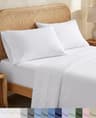
Quick picks

Ranked on published construction and buyer fit. Select a row to jump to the full write-up. We have not slept on any of these — here is exactly what we do instead.

#ProductBest forHow it coolsPrice
1
California Design Den Organic Cotton Percale Sheet Set, Deep Pockets

California Design Den Organic Cotton Percale Sheet Set, Deep Pockets

Deep mattresses, or a mattress plus a topper

Best overallAirflow (open structure)
$49.99 · View on Amazon

$59.9917% off

Price as of November 3, 2026. #ad How we’re funded

2
THREAD SPREAD Organic Cotton Percale Weave Sheet Set

THREAD SPREAD Organic Cotton Percale Weave Sheet Set

The cheapest way to get the correct weave

Cheapest correct weaveAirflow (open structure)
$29.69 · View on Amazon

$32.9910% off

Price as of November 3, 2026. #ad How we’re funded

3
LANE LINEN 100% Organic Cotton Percale Sheet Set

LANE LINEN 100% Organic Cotton Percale Sheet Set

Almost everyone, as a first move

Best first moveAirflow (open structure)
$44.99 · View on Amazon

Price as of November 3, 2026. #ad How we’re funded

4
Casa Platino 100% Cotton 6-Piece Percale Sheet Set, 15-Inch Deep Pocket

Casa Platino 100% Cotton 6-Piece Percale Sheet Set, 15-Inch Deep Pocket

A certified, absorbent set when the budget is tight

Best certified budget setAirflow (open structure)
$39.99 · View on Amazon

Price as of November 3, 2026. #ad How we’re funded

5
MyGiza Sheets Short Queen RV Sheet Set (60 x 75), 400 Thread Count Egyptian Cotton

MyGiza Sheets Short Queen RV Sheet Set (60 x 75), 400 Thread Count Egyptian Cotton

Getting a natural fiber onto a camper bed without paying the bamboo price

Actual Egyptian cotton (RV size)Moisture wicking
$56.99 · View on Amazon

Price as of November 3, 2026. #ad How we’re funded

6
Amazon Basics Lightweight Brushed Microfiber Sheet Set

Amazon Basics Lightweight Brushed Microfiber Sheet Set

A spare set for a guest bed — not for a hot sleeper

Skip thisLess insulation
$17.52 · View on Amazon

Price as of November 3, 2026. #ad How we’re funded

#1Best overall

California Design Den Organic Cotton Percale Sheet Set, Deep Pockets

The same weave as our top pick in a heavier, longer-lasting cloth, with pockets deep enough for a topper. Buy this one if you have already added height to the bed.

What it gets right

  • Deep pockets — the failure mode once you add a 3-inch topper is a fitted sheet that pops off at 4am
  • Organic cotton, percale weave
  • Substantial hand-feel that survives repeated hot washes

Trade-offs

  • Costs more than the LANE LINEN set for the same fundamental weave
  • Heavier cloth takes longer to dry
  • Listing does not publish GSM
Published specifications
Material100% organic cotton
How it cools (our read)Airflow (open structure)
WeavePercale
Thread countNot published
Fabric weight (GSM)Not published
Certifications statedNone stated

Why the construction matters. Deep-pocket construction is the spec most people discover they needed only after buying a topper. Check your mattress height plus topper height before ordering any fitted sheet.

Specifications read from the product listing on July 23, 2026. “Not published” means the listing does not state that figure.

#2Cheapest correct weave

THREAD SPREAD Organic Cotton Percale Weave Sheet Set

Organic cotton in a percale weave at the bottom of the price band. The right answer when the budget is tight and you want the mechanism that works.

What it gets right

  • Percale weave — the property that matters, at the lowest price we found it
  • Organic cotton
  • Straightforward listing that names the weave rather than hiding behind 'cooling'

Trade-offs

  • Thinner cloth than the pricier percales here
  • No thread count or GSM published
  • Wrinkles like all percale
Published specifications
Material100% organic cotton
How it cools (our read)Airflow (open structure)
WeavePercale
Thread countNot published
Fabric weight (GSM)Not published
Certifications statedNone stated

Why the construction matters. Naming the weave in the title is a small signal that a seller understands its own product. A great many 'cooling' sheet listings never mention weave at all.

Specifications read from the product listing on July 23, 2026. “Not published” means the listing does not state that figure.

#3Best first move

LANE LINEN 100% Organic Cotton Percale Sheet Set

Percale in organic cotton at a price where you can own two sets and never sleep on a damp one. If you only change one thing about your bed, change to this weave.

What it gets right

  • Percale is a plain one-over-one-under weave — the loosest common cotton structure, so air moves through it
  • Cotton absorbs sweat instead of sitting on top of it the way polyester does
  • Cheap enough to buy two sets, which matters more than any single feature

Trade-offs

  • Crisp rather than silky — genuinely a different feel, and some people dislike it
  • Wrinkles out of the dryer; percale always does
  • Listing does not publish a thread count or GSM
Published specifications
Material100% organic cotton
How it cools (our read)Airflow (open structure)
WeavePercale
Thread countNot published
Fabric weight (GSM)Not published
Certifications statedNone stated

Why the construction matters. Percale is defined by the weave, not the thread count: one thread over, one under, which leaves more open area between yarns than sateen's four-over-one float. That open area is the cooling.

Specifications read from the product listing on July 23, 2026. “Not published” means the listing does not state that figure.

#4Best certified budget set

Casa Platino 100% Cotton 6-Piece Percale Sheet Set, 15-Inch Deep Pocket

The cheapest set we can find that states a weave AND an OEKO-TEX certification in the same listing. Those are the two things worth checking if your skin reacts to bedding, and almost nothing at this price states either.

What it gets right

  • Names percale, so you know the weave rather than guessing from the word cooling
  • States Oeko Tex certification — a finished-article test, which is the one that covers dyes and residual finishing chemistry
  • 100% cotton with no polyester in the blend, so there is no strong synthetic fiber to anchor pills to the surface
  • Six pieces including four pillowcases, which makes a wash-twice-a-week routine practical

Trade-offs

  • The listing does not state which OEKO-TEX standard or product class, so you cannot look the certificate up
  • No thread count, cotton staple length or GSM published
  • Sold in dyed colorways; if synthetic dyes are your specific trigger a plant-dyed or undyed set is the safer buy
  • Percale starts crisp rather than soft, which some people read as scratchy for the first few washes
Published specifications
Material100% cotton
How it cools (our read)Airflow (open structure)
WeavePercale
Thread countNot published
Fabric weight (GSM)Not published
Certifications statedOeko Tex certified (standard and class not stated by the listing)

Why the construction matters. OEKO-TEX Standard 100 tests the finished article against a list of over 1,000 harmful substances, with stricter limits the more intensive the skin contact — bed linen falls in Product Class 2. A listing that names the certification without naming the standard or class is weaker evidence than one that does, but it is still more than the category usually offers.

Specifications read from the product listing on October 27, 2026. “Not published” means the listing does not state that figure.

#5Actual Egyptian cotton (RV size)

MyGiza Sheets Short Queen RV Sheet Set (60 x 75), 400 Thread Count Egyptian Cotton

Cotton on an RV bed for half the price of the bamboo set, from a listing that tells you the weave instead of leaving you to guess. Most RV sheet listings do not.

What it gets right

  • States its weave outright — sateen — which almost no RV short queen listing does
  • 100% long-staple cotton, so the cloth absorbs sweat rather than leaving it on your skin
  • OEKO-TEX Standard 100 named on the listing
  • Publishes the cut size of every piece: fitted 60 x 75 with a 15-inch pocket, flat 90 x 102

Trade-offs

  • Sateen's long floats make a denser, warmer face than percale, which is the weave we recommend first everywhere else
  • 400 thread count is a selling number, not a cooling one
  • A 15-inch pocket is a lot of spare fabric on a factory RV mattress, and bunched fabric under you is extra insulation
  • No fabric weight published, which is the figure that would settle it against the cheaper cotton sets
Published specifications
Material100% Egyptian cotton
How it cools (our read)Moisture wicking
WeaveSateen
Thread count400
Fabric weight (GSM)Not published
Certifications statedOEKO-TEX Standard 100

Why the construction matters. Cotton absorbs into the fiber rather than transporting liquid to the surface the way lyocell does, so it holds moisture away from your skin but dries more slowly. In a weave this dense that trade is the whole story: you are buying the fiber, and accepting the weave, because no RV short queen listing we read publishes a percale.

Specifications read from the product listing on September 29, 2026. “Not published” means the listing does not state that figure.

#6Skip this

Amazon Basics Lightweight Brushed Microfiber Sheet Set

Skip this one

Skip this if heat is your problem. It is a fine cheap sheet and a bad cooling sheet: brushed microfiber is polyester with a raised nap, which is the opposite of an open weave, whatever the listing says.

What it gets right

  • Very cheap, durable, and it does not wrinkle
  • Fine for a cold room or a guest bed

Trade-offs

  • Brushed nap traps a layer of still air against you — that is insulation, not cooling
  • Polyester does not absorb sweat, so moisture stays on your skin
  • 'Cooling' appears in the listing with no named fiber technology behind it
Published specifications
MaterialBrushed polyester microfiber
How it cools (our read)Less insulation
WeaveNot published
Thread countNot published
Fabric weight (GSM)Not published
Certifications statedNone stated

Why the construction matters. Brushing raises fiber ends to create loft. Loft is trapped air. Trapped air is insulation. This is the clearest example on the site of a listing using 'cooling' for a construction that does the opposite.

Specifications read from the product listing on July 23, 2026. “Not published” means the listing does not state that figure.

Common questions

Is Egyptian cotton good for hot sleepers?

It depends entirely on the weave, which the name says nothing about. Egyptian cotton in a percale weave is an excellent hot-sleeper sheet. Egyptian cotton in a high-thread-count sateen is the warmest cotton sheet you can buy, because the smooth dense face traps a layer of warm air against you. The fiber claim and the temperature outcome are independent, and most Egyptian cotton sold in the US is sateen.

Are Egyptian cotton sheets hot?

The ones most people buy are, and it is a weave problem rather than a fiber problem. Long-staple fiber spins into a fine, strong yarn, which is what makes very high thread counts possible, and high counts are nearly always woven as sateen. So the typical Egyptian cotton sheet is dense and smooth - warm. The same fiber woven as percale is light and open, and sleeps cool.

What is extra-long staple cotton?

Staple length is the average length of the individual cotton fibers. Per Textile World, a cotton's fibers need to be at least 1 3/8 inches long to earn the extra-long staple designation. Egyptian cotton, American Pima and Supima are all ELS cottons. The practical effect is stronger, finer yarn, which makes the fabric more durable, less prone to pilling and capable of being woven very fine - for better or for worse.

Is Egyptian cotton better than regular cotton for sleeping?

Better to own, not necessarily better to sleep on. The longer fibers make a stronger yarn, so the fabric survives more washes before thinning and pills less. That is a durability and comfort upgrade. It is not a cooling upgrade, and a plain upland-cotton percale set will sleep cooler than an Egyptian sateen that costs four times as much.

How can you tell if Egyptian cotton is real?

Look for the Egyptian Cotton trademark and check the brand against the Egyptian Cotton Association's own licensee list, which is published in three categories: Accredited, Suspended and Blacklisted. The association states it can identify the genomic fingerprint of the cotton and run DNA tests to confirm the fiber is genuine. If a listing simply uses the words without the mark, judge the sheet on its stated weave and fiber percentage instead.

What thread count should Egyptian cotton sheets be?

For a hot sleeper, low - roughly 200 to 400 in a percale weave. Thread count measures how many yarns are packed into a square inch, and packing more in makes the fabric denser, which makes it warmer. Counts above about 600 also usually indicate a sateen weave and sometimes indicate multi-ply yarns being counted more than once. Choose the weave first and let the thread count be whatever it is.

What should I buy instead of Egyptian cotton sheets?

A 100% cotton percale set, from any reputable brand, and a second one so you can change the bed mid-week. Weave, fiber purity and owning two sets all do more for a hot night than staple length does. If you want an upgrade after that, linen and lyocell both beat cotton on moisture handling - we compare them on our cooling sheet materials page.

Sources

Try the cheap thing first

Work down this list in order. Each step costs more than the one above it, and most people stop before the bottom. Replacing a mattress to fix a problem your sheets were causing is the most expensive mistake in this category.

  1. 1Pillowcase, then pillowUnder $20 to start
  2. 2Sheets$25-$60
  3. 3Top layer$30-$90
  4. 4Topper or pad$30-$300
  5. 5The mattress$200-$900

Before any of it: work out which one is actually your problem. If your bedroom is 78°F, none of these will save you.