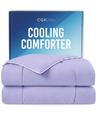
Cold-touch or “Q-Max” fabric pulls heat out of your skin fast and then saturates at your body temperature, so it is a poor all-night bedding feature and a good throw feature— a throw is used in short bursts, moved around, and flipped. Rank throws on what both faces are made of, and on whether the size is really a throw. Our pick is the Elegear double-sided Arc-Chill 3.0; the budget pick is the CGK 50 x 60 throw. Prices are read live as of November 22, 2026.
This site spends a lot of words warning people off cold-touch cooling. It is worth being equally clear about the exception, because an argument that applies everywhere is usually not an argument at all.
Why cold-touch fabric is wrong for a bed and right for a throw
Cold-touch cooling is conduction. A fabric with high thermal conductivity and a smooth, dense surface accepts heat from your skin quickly on first contact, which registers as cold. It keeps doing that until the fabric reaches your temperature, and then there is no gradient left and nothing happens. The number sellers print — Q-Max — is produced by instruments that measure the peak heat flux over the first instants of contact. It is a first-touch index by construction, and it is measured by a contact thermal tester rather than by anyone sleeping.
On a mattress pad or a duvet you keep the same contact for eight hours, so the effect is over in minutes and the eight hours that follow are the product you actually bought. That is why our Q-Max cooling ratings page is as sceptical as it is.
A throw is the opposite situation. You pull it over your legs for forty minutes. You move, you shift it, you fold it back. Contact is short and repeatedly renewed, which is exactly the regime where conduction keeps delivering. A cold-touch throw in a warm living room is one of the few cooling products that performs the way its listing implies — not because the fabric is better than we said, but because the use is different.
The criteria
1. What is the other face? Almost every cold-touch blanket is double-sided with a different fabric on the reverse, and the reverse is where sellers economise. A cold-touch face backed with brushed polyester means that half the time you are lying on polyester, which is the worst surface in bedding for sweat. A cold-touch face backed with viscose or cotton gives you a genuine choice of two useful sides.
2. Is it actually throw-sized?A throw is roughly 50 by 60 to 50 by 70 inches — one person, lap and legs, foldable, washable, easy to grab. A queen blanket at 90 inches square is a bed blanket, and using one as a throw means most of it is on the floor. Only one product in our registry is built at real throw dimensions.
3. Does the listing publish a figure at all?Two of the picks here publish a Q-Max value. We do not treat that figure as a performance guarantee, but a seller who prints a number has at least committed to something checkable, which is more than “ice silk feeling” does.
4. Is the fiber content stated? This is the weak spot of the whole category and we are going to be blunt: most cooling-throw listings, including two of the picks on this page, state no fiber content at all. Our product tables say so rather than guessing. If you want a throw whose fiber you can read, buy the cotton one.
The picks
Elegear double-sided cooling blanket, Arc-Chill 3.0, Q-Max > 0.5 — the pick. Publishes its cold-touch figure, is built double-sided so you always have an unwarmed face to roll onto, and at 79 by 86 inches it covers two people on a sofa or works as a summer-only top layer on a bed. Cons: Q-Max measures the first instants of contact and nothing beyond them, and the listing states no fiber content for either face.
CGK cooling comforter throw, 50 x 60 in— the budget pick and the only genuine throw here. Right size, light, quilted, cheap enough to keep one on each sofa. Cons: no fiber content published, no GSM, and it is strictly a one-person blanket — too small to share and too small for a bed.
Bedsure 100% cotton muslin blanket, four-layer gauze— the pick if the fiber matters more to you than the first-touch sensation, and for most of our readers it should. Four layers of open leno-style cotton gauze: nothing conducts, nothing feels cold, and the whole thing breathes continuously and absorbs moisture because it is cotton. It is also the only pick here whose fiber content is unambiguous. Cons: bed-sized rather than throw-sized, no cold-touch effect at all, and cotton gauze creases permanently in the wash.
PHF Arc-Chill quilted cooling blanket, rayon-from-bamboo reverse— the best answer to criterion one on this page. Cold-touch Arc-Chill on one face, rayon derived from bamboo on the other, so flipping it is a real choice between conduction and absorption rather than a choice between nylon and polyester. Cons: the quilted build adds loft, which is insulation, and no GSM or Q-Max figure is published.
Topcee Q-Max 0.5 cooling blanket — skip this.A cold-touch nylon face over a polyester reverse. The cold face is fine and does what the Elegear’s does; the problem is the other side. Half the time you use a double-sided blanket you are on the other side, and here that side is brushed polyester — a fiber that cannot absorb moisture, so your sweat stays between you and the cloth. It is our standing skip on cooling blankets under $100 for the same reason, and nothing about the throw use case changes it.
Both faces, as each listing states them. 'Not published' means the listing states no figure or no fiber content.| Blanket | Face 1 | Face 2 | Size stated | Q-Max stated |
|---|
| Elegear Arc-Chill 3.0 | Arc-Chill cold-touch | Arc-Chill cold-touch (double-sided) | 79 x 86 in | > 0.5 |
| CGK throw | Not published | Not published | 50 x 60 in | Not published |
| Bedsure cotton muslin | 100% cotton gauze | 100% cotton gauze | Queen, 4-layer | None — no cold-touch claim |
| PHF Arc-Chill quilted | Arc-Chill cold-touch | Rayon from bamboo | Not published | Not published |
| Topcee Q-Max (skip) | Cold-touch nylon | Polyester | Not published | 0.5 |
Read the Face 2 column. It is the column that decides what you are lying on half the time, and it is the column sellers hope you skip.
Washing a cold-touch throw without killing the effect
The cold-touch feel comes from a smooth, dense fabric surface, and anything that roughens or coats that surface reduces it. Fabric softener is the main offender: it leaves a lubricating film on the fiber, which is exactly what you do not want on a surface sold for thermal contact. Wash cold, skip the softener, tumble low or line dry, and keep it out of loads with zips and velcro, which snag synthetic faces. Cotton gauze is the opposite — wash it however you like and accept the crinkle. The general routine is on how to wash a cooling blanket.
Throw, blanket or comforter?
A throw is for being awake in a warm room. A blanketis a bed layer you can add and remove — if that is what you want, the woven options on best waffle blankets breathe better than anything on this page. A comforteris the insulating top layer you sleep under all night, where cold-touch faces are least useful and fill weight is the decision — best cooling comforters. Buying across those categories is the most common mistake in this aisle; the map is on comforter versus duvet versus quilt.
How we picked these
Both faces read, size checked against what a throw actually is, Q-Max treated as a first-touch index rather than a performance score — the method is on how we pick. We have not slept under these, laundered them or measured their thermal contact, and we never claim to have. Each listing was read on the date stamped in its product table and confirmed as a live, in-stock offer before we featured it, and every figure above is either stated on the listing or marked “Not published”. Prices come from the live layer at render time.