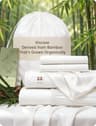
For night sweats, prioritize absorbency and drying speed over airflow. Lyocell, bamboo viscose and engineered wicking polyesters such as Coolmax move liquid away from your skin fastest. Owning two sets so one is always dry does more than any single fabric upgrade. Persistent heavy sweating is a conversation for a doctor.
We cover the thermal environment: mattress, bedding, room. We do not cover why you are sweating — that is outside what bedding can fix and outside what we know anything about. What follows is entirely about the fabric.
Why the usual advice is wrong here
Most cooling-bedding advice optimizes for airflow, and for someone who wakes up hot and dry that is correct. If you wake up damp, airflow alone is not the binding constraint. Liquid sweat sitting on your skin under a sheet that cannot absorb it will keep you clammy no matter how open the weave is.
What you want instead is a fabric that pulls liquid off your skin quickly, spreads it across a wide surface area, and gives it up to the air fast. Those are three separate properties and they do not always come together.
Fibers ranked for sweat rather than for heat. Our read of published fiber properties.| Fabric | Pulls sweat off skin | Dries | Notes |
|---|
| Coolmax polyester | Fastest | Fastest | Moves liquid without absorbing it; can feel clammy in humid air |
| Lyocell / Tencel | Fast | Fast | Absorbs into the fiber; best all-round choice here |
| Bamboo viscose | Fast | Moderate | Very absorbent; slower to release once saturated |
| Linen | Moderate | Fast | Holds a lot of moisture before feeling wet |
| Cotton percale | Moderate | Moderate | Good but can feel heavy once genuinely soaked |
| Brushed microfiber | Poor | Moderate | Does not absorb; holds moisture against the skin |
The two changes that matter more than the fabric
Own two sets. This is unglamorous and it is the single highest-impact thing on the page. A damp sheet does not behave like the fabric you bought; it behaves like a wet cloth. Being able to strip and remake the bed at 3am, or simply to start every night on a genuinely dry set, changes more than upgrading from a good fabric to a slightly better one.
Add a washable protector layer, and skip fabric softener.Softener works by depositing a thin coating on the fibers, and that coating is hydrophobic — it directly reduces the absorbency you are paying for. A breathable, washable mattress pad or protector also keeps sweat out of the mattress itself, which matters because a foam mattress that has absorbed months of moisture cannot be laundered.
The pads and protectors that handle sweat best, ranked on what sits between you and the film, are on mattress pads and protectors for night sweats.
What to buy
- Heavy sweating, dry climate: a Coolmax set. It moves liquid faster than anything else here.
- Heavy sweating, humid climate: lyocell. Evaporation is slow in humid air, so you want a fiber that can hold the moisture inside itself rather than one that only relocates it to the surface.
- Sweating plus feeling hot: linen. It is the one fabric that does both jobs adequately, and the only reason it is not the default recommendation is price.
- Any of the above: two sets, washed weekly, no fabric softener.
- What you wear to bed: the same fiber rules apply, plus one more — how much of you it covers. Picks for men and women are on the best cooling pajamas.
- Buying for someone else: the same picks, explained for a gifter who does not have the problem, are on gifts for someone with night sweats.
What we required before a sheet set could appear here
Every set below had to clear the same four tests, and they are deliberately different from the tests we apply on a general cooling roundup, because the problem is different. Airflow is not the binding constraint when the constraint is liquid.
- The listing names the fiber.Not “cooling fabric”, not “breathable blend” — the actual fiber, because fiber is what decides whether sweat is absorbed, moved or left on your skin. A set that will not name it has told you nothing about the only property that matters here.
- The fiber does something with liquid. Either it absorbs into itself (cotton, linen, lyocell, viscose) or it is an engineered transport fiber that moves liquid across itself and releases it (Coolmax). Plain polyester microfiber does neither, which is why the one microfiber set here is the skip.
- It survives a weekly hot-ish wash. Anything recommended for night sweats is going in the machine far more often than average bedding, so a fabric that pills, shrinks or loses its finish in ten washes is not a candidate whatever it does on night one.
- It is currently purchasable. Every set was resolved from a live Amazon listing on the date stamped in its write-up, and prices are pulled live rather than typed in by us. The method is on how we pick.
How to read the picks
Our best overall is lyocell, and it wins for the reason the table above gives: it pulls liquid off your skin quickly and takes it into the fiber, which is the combination that keeps working when the air is too humid for fast evaporation. It is the safest choice if you are not sure which half of the problem you have. Its honest limitation is that it is a smooth, drapey cloth that lies against you, so it does less for airflow than a percale would.
The fastest wicking pick is the engineered polyester. Coolmax is a named, specified transport fiber rather than plain polyester with a marketing word attached, and nothing else here moves liquid off skin faster. The catch is that it moves liquid without ever absorbing it: in a dry room that is exactly what you want, and in a humid one the moisture has nowhere to evaporate to and it can feel clammy. Buy it for a dry climate and heavy sweating.
The most absorbent pick is bamboo viscose, which takes more moisture into the fiber than anything else on the page. That is the right property when you are producing a lot of it at once. The trade is on the way back out: viscose is slower to release what it has absorbed, so a set that is genuinely saturated stays damp longer than lyocell does. Which is the argument for the fifth pick.
The hot as well as damp pick is linen, the one fabric here that handles both halves of the problem adequately. It holds a great deal of moisture before it feels wet, it dries fast, and its open structure moves air the way none of the smooth fabrics do. The only reason it is not the default recommendation on this page is the price, and the break-in period: linen is stiff and slightly rough until it has been through the wash several times, which is a real cost people are not warned about.
The best second set is the most important pick on the page and the cheapest. Everything above assumes you are starting the night on a dry sheet, and if you own one set you frequently are not. Cotton percale is inexpensive enough to own two sets of, it absorbs, and it is the most open weave in common use so it dries fast on the line. Buy your best fabric once and buy this twice; the rotation does more than any single upgrade in this category.
The skip is the best-selling sheet material in the world and the worst one for this specific problem. Brushed polyester microfiber does not absorb, so sweat stays on the surface between the fabric and your skin, which is precisely the sensation you are trying to get rid of. It is warm, it is soft, it is cheap, and if you wake up damp it is working against you. The longer version is on do microfiber sheets sleep hot.
If the sheets are handled and you are still waking up soaked, the next thing to change is what is on top of you — see cooling blankets and comforters. The wider fabric comparison, including everything we did not pick, is on our cooling sheets roundup.
The top layers ranked for this exact problem, from waffle blankets to absorbent duvet covers, are on the best blankets and comforters for night sweats, and the sets we would buy for a humid room are ranked on the best sheets for hot, humid weather.
And if what wakes you is heat rather than dampness, and it is reliably the same hour, the explanation is on why you wake up hot in the middle of the night.