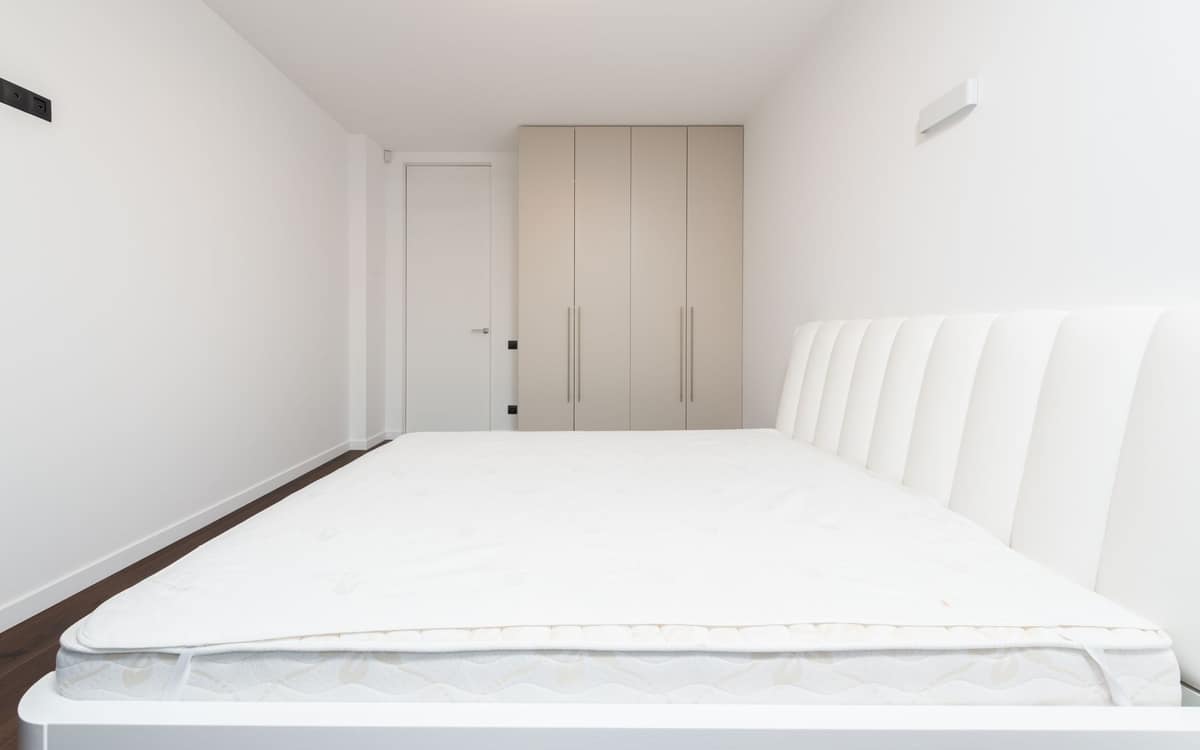
Replace a mattress when a straight edge laid across the bare bed shows a permanent dip where you sleep, when you consistently sleep better somewhere else, or when the foam has softened enough that you now sink into a pocket you did not used to. Ignore the seven-to-ten-year rule: we read every mattress listing in our registry and not one publishes a warranty term, a coil count, a coil gauge or a foam density, so there is no manufacturer figure anywhere behind it. If the bed is still level and you simply want a different surface, a topper is the cheaper answer and it is genuinely the right one.
A mattress is the most expensive thing on our escalation ladder and the last thing we tell anybody to change, so this page is deliberately written to talk you out of it where that is honest. It is also the page where the gap between what the industry says and what the industry publishes is widest.
What mattress listings actually publish about durability
We went looking for the source of the familiar interval, in the only place that could settle it: what the manufacturers themselves commit to in writing on the listing you buy from.
Across the five mattresses in our registry — two 12-inch pocket-coil hybrids, a 14-inch latex euro-top hybrid, a 10-inch organic cotton, wool, latex and coil bed, and a 10-inch all-foam bed — not one publishes a warranty term. None publishes a coil count or a coil gauge, which are the two specs that distinguish one hybrid from another. None publishes a foam density, which is the single number that predicts how fast a foam layer softens. None publishes a weight limit.
What they do publish is height and listed weight. Those are useful for sheets and for carrying the thing upstairs, and they tell you nothing about year six. So the familiar rule of thumb is not coming from the manufacturers, and we are not going to launder it into a fact by repeating it with a number attached.
The four tests
Since the date is unavailable, use the condition. Do the first two with the bed completely stripped, including any topper and protector.
The straight-edge test. Lay a long spirit level, a broom handle or the edge of a door across the bare mattress at hip height, side to side. Look at the gap underneath. A sound mattress sits close to the straight edge the whole way across. A worn one shows a trough where you sleep and often a ridge up the middle where nobody does. This is the single most decisive check available to you, and it costs nothing.
Manufacturers’ warranties generally define a failed mattress as one with a body impression deeper than some stated figure. Not one of our listings publishes that figure, so we are not going to quote a threshold as though it were a standard. Use your own eye: a dip you can see from across the room is beyond arguing about.
The sink test. Lie on your side in your usual spot and pay attention to whether your hip and shoulder are sitting in a pocket. On an all-foam or foam-topped bed, softening is a more common failure than visible sagging, and it is sneakier: the bed still looks flat when empty but no longer holds you level under load. If your spine curves in the bed in a way it does not when you lie on a firm floor, that is the finding.
The elsewhere test.If you reliably sleep better in a hotel, at a relative’s house, or on the sofa, and you have ruled out the room being cooler or quieter, that is real evidence. People discount it because it feels subjective. It is in fact a controlled comparison of the one variable you cannot otherwise test, which is a different mattress with the same body on it.
The heat test, which is the one this site is for. If the bed has got hotter over the years with no change in the bedding or the room, the mattress has almost certainly softened. That is the next section, because the mechanism is worth understanding before you spend hundreds of dollars on the wrong layer.
Why an aging mattress sleeps hotter
A new mattress holds you near its surface. An old one lets you down into it, and everything that follows from that is bad for a hot sleeper.
Sinking increases your contact area. Instead of lying on top of the bed, you are in a hollow with material against your hip, your ribs and part of your back, and the surface exposed to room air shrinks accordingly. Heat you generate has fewer routes out, and the hollow traps the air you have already warmed, because nothing is circulating it.
In foam the softening is also the cause. Memory foam is viscoelastic: it yields as it warms, which is how it conforms, and a layer that has been compressed nightly for years yields further and faster than it did when new. That makes the hollow deeper, which increases contact, which holds more heat in, which softens the foam further within a given night. It is a small feedback loop and it is exactly why people describe a bed as having “got hotter” without anything visibly changing.
A coil bed ages differently and usually more gracefully, because the core is mostly air and coils lose tension rather than collapsing into a pit. But the comfort layer above the coils is still foam, and it is still the part touching you. The full explanation of which part of a mattress is making you hot is on why your mattress sleeps hot.
Topper or replacement? The rule
This decision is worth getting right because the two options differ by an order of magnitude in price. The test is structural, not financial.
How to read the straight-edge and sink tests into a decision. The point of the first row is that a topper is often the correct answer, not a consolation prize.| What you found | What it means | What to do |
|---|
| Mattress is level; you want a different surface | Nothing has failed. You are buying comfort, not structure | A topper or a pad. Much cheaper, and the right tool |
| Mattress is level; it sleeps hot | The surface and the bedding are the variables, not the core | Work down the ladder — sheets, pillow, then a pad |
| Visible trough on the bare mattress | Support has failed in one place | Replace. A topper laid over a trough reproduces the trough |
| Bed looks flat but you sink in under load | Foam has softened; the structure is gone even though the shape is not | Replace, and prefer a coil core next time |
The third row is the expensive mistake and it is extremely common. A topper is a flexible layer; laid over a dip it will sit down into the dip within weeks and you will have bought the same problem with an extra layer of insulation on top of it. The full comparison of when each is appropriate is on mattress versus topper.
Check the base before you blame the bed
A mattress can only be as flat as what it is lying on. A sagging box spring, a slatted base with gaps wide enough for the mattress to dish between them, or a frame missing a centre support rail will all produce a trough in a perfectly sound mattress, and will do it again to the new one.
Take the mattress off and look. Slats should be evenly spaced and none should be cracked or bowed; a queen or king frame needs a centre rail with a leg to the floor. This is also the cheapest airflow improvement available to a hot sleeper, because a bed with open space underneath can shed heat downward and a mattress on a solid platform or on the floor cannot — see the bed base and airflow.
If you are replacing it, buy construction rather than adjectives
One thing to take from this page into the purchase: with no coil counts, no gauges and no foam densities published anywhere in this category, you cannot compare models on numbers, so compare them on structure. A pocket-coil core is mostly air and air is the only thing in a mattress that moves heat. A latex comfort layer does not soften around you the way viscoelastic foam does. An all-foam bed is the construction that sleeps hottest, and no amount of gel or green tea in the listing changes that — which is why the all-foam bed among our picks is the skip.
Then protect it. A mattress you cannot wash is a mattress whose lifespan is decided by what reaches it, and if you sweat enough to be reading this site, the cheapest thing you can do for the next bed is put a breathable protector on it from day one. The one in our picks is the only protector in our registry that publishes a fabric weight. The full set of replacement options, ranked on construction, is on our cooling mattress picks. We own none of these beds and have slept on none of them, which is set out on how we pick.
One thing that is noton that list is staining. A yellowed mattress with good support has years left in it, and the discoloration is cosmetic — the three signals that do mean the bed is finished, and how to lighten the mark in the meantime, are on how to get sweat stains out of a mattress.