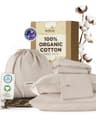
Buy an absorbent fiber with a finished-article certification, in a weave the listing will name, with nothing added to it. The contact-dermatitis literature consistently points at the additivesrather than the fiber — disperse dyes are described in review after review as the most important allergens in textile dermatitis, and crease-proofing resins leave residual formaldehyde on finished cotton. That reframes the whole shopping problem: you are not looking for a magic hypoallergenic fabric, you are looking for a sheet with the fewest added substances on it. Our pick is the Casa Platino percale, because it is the cheapest set we could find that states both a weave and an OEKO-TEX certification. If synthetic dye is your confirmed trigger, the AIZOME plant-dyed set removes that class entirely and costs accordingly. Wash whatever you buy before you sleep on it, and never use fabric softener again.
A note on what this page is. We are not treating a skin condition and we cannot diagnose one. What a bedding site can usefully do is help you remove variables in a controlled way — and the variables in a bed sheet are better documented than most people shopping for one realize.
Heat is not a separate problem from the skin problem
Start here, because it is the part most sensitive-skin bedding advice leaves out entirely.
If you sleep hot, you sweat, and what happens to that sweat is decided by the fabric touching you. An absorbent fiber pulls moisture off your skin and moves it into the yarn where it can evaporate. A non-absorbent fiber — polyester, in any of its marketing names — leaves it where it landed, sitting between skin and fabric in a warm, enclosed, slightly abraded layer. That is occlusion, and occluded sweat on warm skin is a recognized irritant in its own right, before any question of allergy comes into it.
So the first criterion on this page is the same as the first criterion everywhere else on this site: buy a fiber that absorbs. Cotton, linen and lyocell do. Polyester does not, and brushed polyester microfiber additionally traps a layer of still air against you, which makes the enclosure worse. The thermal case is on microfiber sheets and heat; the skin case is the same mechanism read a different way.
What the dermatology literature actually blames
Two things, repeatedly, and neither of them is a fiber.
Dyes. A review of the literature on disperse dyes published in Contact Dermatitisin 2013 opens from the position that “several disperse dyes (DDs) are still considered to be the most important allergens in textile dermatitis,” and reports that in screening studies the average prevalence of sensitization was above 1% for Disperse Blue 106, Disperse Blue 124 and Disperse Orange 3. The review also notes there are sparse data on how widely these dyes are still used, which is a limitation worth carrying.
Here is why that matters for a cooling-sheet buyer specifically: disperse dyes are the dye class used to color syntheticfibers, because polyester will not take the reactive dyes used on cotton. The sheet most likely to be dyed with the class most implicated in textile dermatitis is therefore the cheap brushed-microfiber “cooling sheet” — the same fabric that also fails on absorbency and on airflow. Three separate arguments, one conclusion.
Finishes.The other documented additive is crease-proofing chemistry on cotton. A 2000 WestPoint Stevens patent on wrinkle-free cotton sheeting states that DMDHEU “remains the most widely used creaseproofing agent in the United States” and that it “has the disadvantage of high residual parts per million formaldehyde on the fabric after curing.” If a cotton sheet is sold as wrinkle free, easy care or no-iron, that is what is doing it. We go through the durability cost of the same finish on cooling sheets that don’t wrinkle or pill.
Our read, labeled as ours:put those two findings together and the usual advice — buy bamboo, it is hypoallergenic — is answering a question nobody asked. “Hypoallergenic” is an unregulated marketing word in the United States with no test behind it. A dyed, resin-finished bamboo viscose sheet carries exactly the additives this section is about; an undyed, unfinished polyester one would carry fewer. The fiber is the wrong axis. What is on the fiber is the right one.
The five things we looked for
1. A finished-article certification, not an agricultural one. This is the criterion that did most of the work, and the distinction inside it matters. OEKO-TEX STANDARD 100 tests the finished productagainst a list of “over 1,000 harmful substances,” with limits that get stricter the more intensive the skin contact — bed linen sits in its Product Class 2, and Class 1, for babies and children up to three, “has the strictest requirements and limit values.” GOTS is a different guarantee: it certifies organic fiber content and processing. Both are worth having. Only one of them is a test of what is left on the cloth you sleep against.
2. An absorbent fiber. Cotton, linen or lyocell. For the reason in the section above.
3. Nothing added.No wrinkle-free or easy-care claim, no antimicrobial treatment, no “cooling finish” applied as a topical coating. Every added function is an added substance, and a cooling structure— an open weave in an absorbent fiber — outperforms a cooling coating anyway. The mechanisms are compared on cooling sheet materials.
4. A weave on the listing. Not a skin criterion as such, but the most useful fact a cooling-sheet listing can publish, and a proxy for whether the seller knows what it is selling. Percale is the open, crisp, best-ventilated construction; sateen is smoother against the skin with less surface friction. Which one suits you depends on whether your skin objects to texture or to heat: percale versus sateen.
5. A light or undyed colorway, where dye is the suspicion. Less dye is less dye. A white or ivory cotton set is a cheap way to narrow the variable before spending serious money on plant-dyed bedding.
What we are not going to claim
If you’re drenched most nights, or it started suddenly, that’s worth raising with a doctor — it’s outside what bedding can fix, and outside what we cover.
There is a large market in bedding sold as a treatment for skin conditions, and the trial evidence for that idea is weaker than the marketing. The best-powered study we have found is the CLOTHES trial, published in PLOS Medicine in 2017, which gave 300 children with moderate to severe eczema specialist silk garments on top of standard care and concluded that silk clothing is unlikely to provide additional benefit. That tested clothing rather than sheets, and silk rather than cotton, so it does not settle every question. It does set the expectation: a fabric is not a therapy.
What this page is good for is the opposite and more modest job. If your skin reacts to something in your bed, there are four candidate variables — the dye, the finish, the detergent, and the mites — and each one can be removed and tested one at a time. If you have a diagnosed skin condition or a confirmed contact allergy, the person to plan that with is the clinician who diagnosed it. Ask them what to patch test; do not ask a website.
How the picks compare
Every row was read from the Amazon listing on 2026-10-27, the same day we confirmed a buyable offer for each. A blank is a fact the listing does not publish — which, in this category, is most of them. No price is stored on this site; the figures on the cards above come from the live price layer. | Fiber | Weave stated | Certification stated | Dye |
|---|
| Casa Platino percale | 100% cotton | Percale | Oeko Tex (standard/class not stated) | Conventional, dyed colorways |
| Bedsure PureWoven organic | 100% organic cotton | — | GOTS + OEKO-TEX | Conventional |
| AIZOME plant-dyed | 100% organic cotton, 340 TC | — | GOTS | Plant-dyed, states no synthetic dyes |
| Stylinen organic lyocell | 100% organic eucalyptus lyocell | — | None stated | Conventional |
| SureGuard pillow encasement | Cotton with a membrane | — | GREENGUARD Gold | Undyed white |
| Amazon Basics microfiber (skip) | Brushed polyester | — | None stated | Disperse-dyed synthetic |
Two honest observations about that table. First, not one of these listings publishes a certificate number, so you cannot look any of them up in the issuing registry — OEKO-TEX runs a public label check precisely for that purpose and the category almost never gives you the input. Second, the only set here with no certification at all is the lyocell, which is on the page anyway because surface smoothness is a genuine and different need: if your skin is actively raw, friction may matter to you more than residues do.
If mites are your trigger, sheets are the wrong layer
Dust mite allergy is a separate problem with a separate fix, and a hot sleeper is at a specific disadvantage here. The Asthma and Allergy Foundation of America advises washing bedding weekly at 130 °F or hotter to control dust mites, which feed on shed skin and thrive when indoor humidity sits above 50%. A bed you sweat into every night is that micro-climate, deliberately manufactured.
Sheets are not what mite populations live in; pillows and mattresses are. The intervention that works is a tight-woven encasement on the pillow and the mattress, and the one that matters most is the pillow, because it is inches from your face all night. Ours are on the best cooling pillow protectors and the best cooling mattress protectors. The trade-off is real and we say so on both pages: a membrane that blocks allergens also blocks some moisture movement, which is why we favor the ones with a cotton face.
The other half is the 130 °F wash, which not every fabric survives weekly. Cotton percale does. Lyocell, viscose and anything with elastane do not love it. That is a real argument for cotton if mites are your actual problem, and it is the kind of trade-off that gets lost when a page just tells you bamboo is softer.
The laundry half, which is free
Half of what people blame on a sheet is on the sheet rather than in it, and that half you control.
Wash new sheets before you sleep on them. Always, and twice if you are reacting to something. A first wash takes off surface finishing residues, sizing and loose surface dye. It is the single highest-value thing on this list and it costs nothing.
Switch to a fragrance-free, dye-free detergent and use less of it. Detergent fragrance is a common contact irritant, and overdosing detergent is the usual reason residue survives the rinse. Measure it. If your machine has an extra-rinse option, use it on bedding.
Stop using fabric softener. It deposits a waxy cationic film plus fragrance directly onto the fiber surface that touches your skin for eight hours. It also reduces how much moisture the fiber can absorb, which makes the occlusion problem at the top of this page worse. White vinegar in the rinse softens without coating.
Skip the dryer sheets too. Same objection, same fragrance, deposited by heat.
Then change one variable at a time. Detergent first, because it is free. Then the sheet, to a certified undyed or light cotton. Then the pillow encasement. Trying all three at once tells you nothing about which one was the problem. The full washing routine for cooling fabrics is on how to wash cooling sheets.
What we would actually buy
Start with the Casa Platino percale.It is the only set we found at the bottom of the market that states both a weave and a certification, it is 100% cotton so it absorbs, and percale is the most open sheet construction there is. It survives the 130 °F mite wash. Six pieces including four pillowcases makes the weekly-wash routine a hot sleeper needs actually practical. The caveats are that it does not say which OEKO-TEX standard or class, and that it is sold dyed.
Step up to the Bedsure PureWoven if you want both certifications.GOTS for how the cotton was grown and OEKO-TEX for what is on the finished cloth, on one listing, which is rare. It costs about three times the Casa Platino and it will not tell you its weave — a real gap on a cooling sheet.
Buy the AIZOME set only if dye is your confirmed trigger.Plant-dyed with no synthetic dyes is a precise intervention against the one additive the review literature most implicates, and it is the most expensive bedding on this entire site. Ignore the “FDA-registered” line on the listing, which means nothing for bed sheets, and note that 340 thread count in an unnamed weave will sleep warmer than a percale in the same fiber. This is a dye purchase, not a cooling purchase.
Choose the lyocell if friction is the issue rather than chemistry. A smooth filament fiber in a set with no stated certification is a different trade: less surface drag on raw or healing skin, less information about residues. Wash it twice before use.
And put the brushed microfiber back. It is non-absorbent so it holds sweat against you, it is napped so it traps air, and it is dyed with the class of dyes the dermatology literature most often names. Being the cheapest sheet in the shop is not worth that stack.
Where sheets sit relative to everything else you could change is on what to fix first, and the night-sweats version of this problem is on cooling sheets for night sweats.