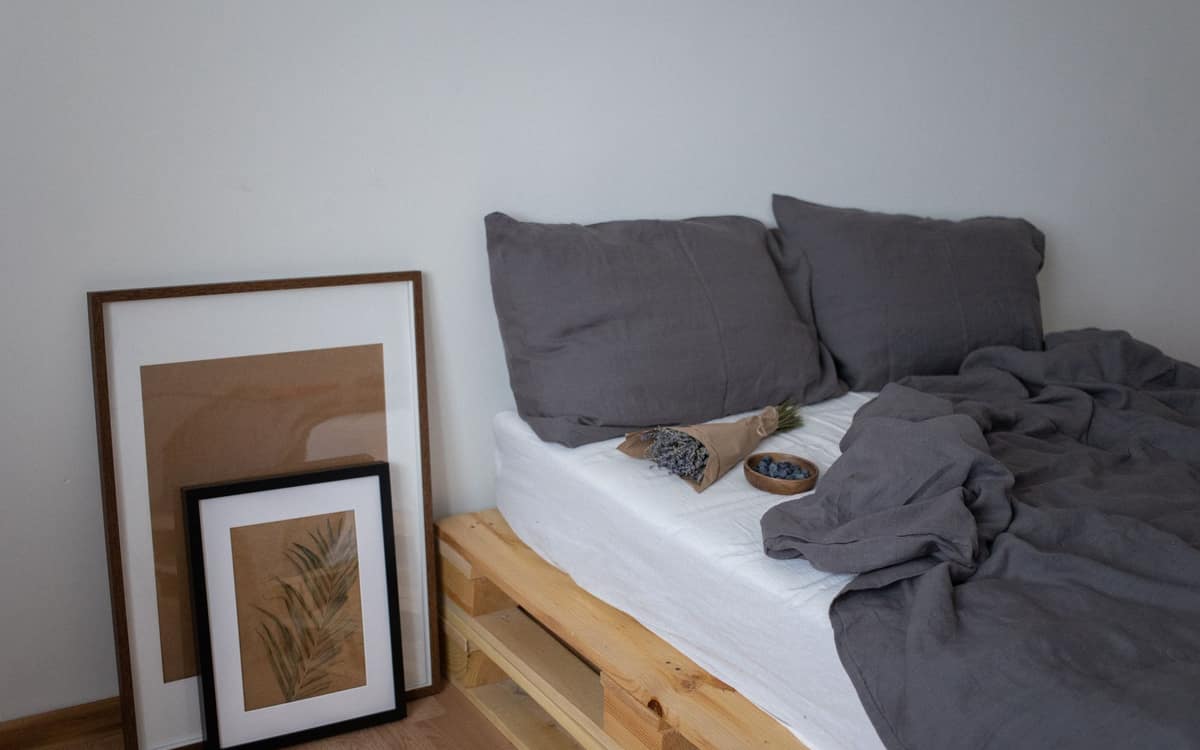
No — not in a dark bedroom, which is where you sleep. Color determines how much visible light a surface absorbs, and a black sheet in sunlight genuinely does get hotter than a white one. At 2am there is no sunlight in the room, so the effect is close to zero. The two things that decide whether a sheet sleeps cool are the weave (open, so air moves) and the fiber (absorbent, so sweat leaves your skin). Our pick on both counts is a cotton percale. Color is worth exactly one consideration, and it is about laundry, not temperature.
This question comes up constantly and it has a satisfying answer, because the physics is simple and the intuition behind it is half right. Wearing a black shirt outdoors on a July afternoon really does make you hotter. It is reasonable to assume a black sheet does the same thing. It does not, and the reason why is worth understanding, because it is the same reason several other popular cooling fixes do nothing.
Why color matters outdoors and stops mattering indoors
A dark surface absorbs more of the visible and near-infrared radiation that hits it; a light surface reflects more of it back. That is a real and large effect, and it is a statement about incoming radiation. Outdoors, the incoming radiation is the sun, delivering on the order of a kilowatt per square meter. Indoors at night, the incoming radiation is whatever is coming off your walls, ceiling and furniture — surfaces at roughly room temperature, radiating in the far infrared.
And here is the part that settles it: in the far infrared, ordinary textiles behave nearly the same regardless of dye. Visible color is a property of how a surface handles the wavelengths your eye can see. The thermal radiation moving around a dark bedroom is at wavelengths your eye cannot see, and the pigments that make a sheet look black have very little effect there. A black cotton sheet and a white cotton sheet in an unlit room are, thermally, the same sheet.
The one honest caveat: if your bed sits in direct morning sun through an uncovered window and you are still in it, a dark sheet will warm up faster than a light one. That is a real scenario for shift workers and anyone with east-facing glass. The fix is the curtain, not the sheet — and it belongs with the other room-level fixes on how to stay cool at night.
What actually decides whether a sheet sleeps cool
Two things, in this order.
The weave.A percale is a plain one-over-one-under structure with gaps between the yarns, so room air moves through the cloth and carries heat with it. A sateen floats several yarns over one, producing a smooth, dense face that lies flat against you and blocks that airflow. Same cotton, same thread count, completely different night. This is the biggest lever available to you and it is usually the cheapest — the comparison is on percale versus sateen.
The fiber.Cotton, linen and the cellulose viscoses absorb sweat into the fiber. Polyester does not — it holds moisture on the surface, against your skin, where it has nowhere to go. That is why a brushed polyester microfiber sheet can be marketed as cooling and still be the worst thing on your bed. The full fiber ranking is on cooling sheet materials.
What each property changes on a bed at night. Color is included for completeness, which is rather the point.| Property | Effect on heat at night | Worth paying for? |
|---|
| Weave (percale vs sateen) | Large — decides whether air moves through the cloth | Yes. The biggest lever, and usually free |
| Fiber (cotton, linen, viscose vs polyester) | Large — decides whether sweat leaves your skin | Yes |
| Fabric weight | Moderate — lighter cloth moves more air | Yes, where published; most listings do not |
| Thread count | Small, and often backwards above about 400 | No |
| Color | Negligible in a dark room | No — buy the color you like |
| Cold-touch finish (Q-Max) | Real for a few minutes, then gone | Only as a get-to-sleep aid |
The one real reason to think about color
Laundry, not temperature. If you sweat at night, sheets yellow — perspiration leaves salts and oils that oxidize over time, and hair and skincare products on a pillowcase do the same thing faster. Light-colored sheets show that discoloration clearly and tolerate the treatment that removes it: oxygen bleach, hot water, sunlight. Dark sheets hide it, which sounds like an advantage and is not — the stain is still there, it just never prompts you to deal with it.
Dark sheets have the opposite problem too. They show detergent residue and hard-water mineral film as a dull grey bloom, and that residue is the thing most likely to have stopped your sheets absorbing properly. If your black sheets look chalky, you are using too much detergent, and the fix is a strip wash rather than more detergent. Both routines are on cooling sheet care and washing.
If the yellowing has already reached the mattress underneath, that is a different job with a different method: how to get sweat stains out of a mattress.
Three related color myths, briefly
“White sheets are cooler.”Only in sunlight. The reason white bedding dominates hotels is that it can be bleached, bulk-laundered and matched across a thousand rooms — an operations decision that got reinterpreted as a thermal one.
“Silver or grey sheets reflect heat back.”A metallic-looking dye is not a metallic surface. Reflecting far-infrared radiation requires an actual conductive layer — the principle behind an emergency blanket — which would make a sheet both noisy and non-breathable. Nobody sells that as bedding, and you would not want it if they did.
“Dark sheets feel hotter, so something must be happening.” Something usually is, just not the color. Dark and jewel-tone sheet sets skew heavily toward sateen and brushed microfiber, because rich dyes look best on a smooth, dense face. If your black sheets sleep hot, check the weave on the label before you blame the dye — and if the label says microfiber, you have found your answer. That fabric is covered on microfiber and heat.
So buy the color you like
Genuinely. Sheets you like the look of are sheets that stay on the bed, and the decision that changes your night is the one on the composition label: an open weave, in a fiber that absorbs. Get those two right and the dye is a matter of taste. Get them wrong and no color will save you.