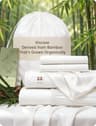
Bamboo is the most misunderstood fabric in this whole category, and the misunderstanding costs people money. It is sold as an open, airy, “breathable” sheet in the same breath as percale, and it is nothing like percale. Almost all “bamboo” bedding is bamboo viscose— a rayon chemically regenerated from bamboo pulp — and it is smooth, dense and drapey. It cools by two mechanisms that have nothing to do with airflow.
How bamboo actually cools, so you buy it for the right reason
It absorbs moisture, fast. Regenerated cellulose holds and moves water vapor far better than cotton and vastly better than polyester. If your problem is that you wake up damp rather than merely warm, this is the single most useful property a sheet can have, and bamboo has more of it than anything short of linen.
It drapes and conducts. A viscose sheet lies flat against your skin like a cool second surface and pulls heat out of you by conduction on first contact, the same way a stone floor feels cold. That is a genuinely pleasant sensation to get into bed on. It is also the reason bamboo is the wrong pick for someone who runs hot but dry: a fabric in full contact with your skin, holding no air, has nowhere to send the heat once it has warmed to your temperature.
So the honest one-line rule is: buy bamboo if you sweat, buy percale if you just feel hot. The full physics is on do cooling sheets work.
What we looked for
- The weave named honestly.“100% bamboo” on a US listing almost always means bamboo viscose. That is fine — viscose is the good part — but a listing that hides it is a listing we trust less on everything else.
- Sateen vs twill vs a stated lyocell. Most bamboo is woven in a sateen that adds to the silky feel and subtracts a little from the airflow. A lyocell (Tencel) version is made in a closed-loop solvent process that is both more durable and less environmentally ugly than conventional viscose.
- Two sets you can afford. The most cooling thing you can do with any sheet is start every night on a dry one. A moderately priced set you can own two of beats a luxury set you own one of.
- No unverifiable claims doing the selling.“Antibacterial,” “three degrees cooler,” and “eco” are the three phrases a bamboo listing leans on when it has nothing measurable to say. We ignored all three.
Reading the three picks
Our best overallis the set that gets the viscose right without pretending to be something it is not — smooth, cool to the touch, and priced so a second set is realistic. The best value pick is the one to buy if you are bamboo-curious and not ready to spend: it does the moisture job at a budget price, with the pilling risk that budget viscose carries. The best true lyocellis the upgrade — a closed-loop fiber that survives more washes before it goes limp, for people who already know they like the feel and want it to last; if that is the direction you are leaning, the full lyocell ranking compares five sets in that fiber. Full write-ups, with the cons stated plainly, are below the table.
Bamboo, lyocell and cotton, side by side
How the three cellulose sheets behave for a hot sleeper. Our read of published construction, not lab measurement. | Bamboo viscose | Lyocell (Tencel) | Cotton percale |
|---|
| Cooling mechanism | Moisture + conduction | Moisture + conduction | Airflow (open weave) |
| Feel | Silky, drapey | Silky, slightly crisper | Crisp, dry |
| Best for | Sweaty, damp sleepers | Sweaty sleepers who wash a lot | Warm, dry sleepers |
| Durability | Lower — can pill and thin | Higher — closed-loop fiber | High |
| Wrinkles | Less | Less | Yes, always |
| Typical price tier | Budget to mid | Mid to premium | Budget to mid |
The honest downsides of the whole category
Bamboo viscose is a regenerated fiber, which means it is weaker wet than cotton and less tolerant of heat. It pills when it is cheap and it thins over a couple of years even when it is not. Wash cold, skip the fabric softener (it coats the fiber and kills exactly the moisture-wicking you paid for), and tumble low or line dry. The care rules matter more here than on any other sheet — the same rules are on how to wash cooling sheets.
And the “eco” halo deserves a caveat: bamboo the plant is sustainable, but conventional viscose processing is a heavy chemical operation. Lyocell is the genuinely cleaner version. If the environmental story is why you are buying, buy the Tencel one and look for an OEKO-TEX or comparable certification rather than the word “eco” on the package.
The other fabric people cross-shop against bamboo viscose is flax, and it works a completely different way — airflow rather than absorption. The comparison is on linen versus bamboo sheets.