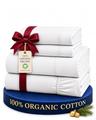
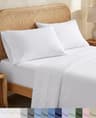
Brooklinen’s own pages put the Classic Percale at 270 thread count in 100% long-staple cotton and the Luxe Sateen at 480 thread count in the same fiber with a four-over-one sateen weave, and state that the linen sets are measured by weight in GSM rather than by thread count because flax is too thick for the number to mean anything. Those are commodity constructions, not proprietary ones. Match the weave and you have matched the thing that decides how hot you sleep: our closest swap for the Classic is the LANE LINEN organic cotton percale set, for the linen line a 100% French linen set, and for the Luxe Sateen a sateen weave in lyocell rather than in cotton. Every price on this page is read live as of November 22, 2026 rather than typed into the text.
Start with the part that is genuinely to Brooklinen’s credit, because it is the reason a swap is even possible. Most of this aisle sells a sheet set as “cooling” and never names the weave at all. Brooklinen built its sheet range around the weave as the product distinction — Classic percale, Luxe sateen, linen — publishes a thread count for each cotton line, and in its own education-center article frames the choice as a cool, crisp Classic Percale or a soft, smooth Luxe Sateen. That is the correct axis. It is also, if you sleep hot, a decision the brand has already made easy for you: by its own description, one of those two is the cool one.
What that means for this page is that there is no mystery to reverse-engineer. We are not guessing at a secret fabric. We are matching a published weave in a published fiber, which is the one thing in bedding that reliably transfers between sellers.
The one rule that makes a sheet swap work
Match the weave, not the price. A weave is a geometry, and geometry is what decides whether room air can move through the cloth lying on top of you.
Percale is a plain weave: one thread over, one thread under, repeated. That is the loosest common structure in cotton bedding, and it leaves the most open area between the yarns. Open area is airflow, and airflow is the only passive cooling mechanism that still works at 4am, because it does not saturate the way a cold-touch surface or a phase-change layer does. It is also the cheapest weave to manufacture, which is why the correct answer in this category costs less rather than more.
Sateenfloats one yarn over four others to build a smooth, light-reflecting face. Those floats sit side by side with very little gap, so the cloth presents a denser, flatter barrier. That is exactly what makes it feel silky, and exactly what makes it the warmer of the two. The higher thread count that comes with it is a consequence of the structure rather than an independent virtue — you need finer yarns to pack that many into an inch. The full argument, including what the number does and does not tell you, is on percale versus sateen and thread count and cooling.
Linenis a different fiber rather than a different weave. Flax yarn is thick, irregular and stiff, so the cloth holds itself off the skin in a way no cotton does, and the fiber absorbs a lot of water before it feels wet. Because the yarn is thick, thread count is meaningless and the trade measures linen in GSM instead — which is what Brooklinen says on its own pages, and it is correct.
If you were buying the Classic Percale
This is the easy case and the common one. All three picks below are the same weave in the same fiber.
LANE LINEN organic cotton percale— the closest swap and our overall pick. Plain-weave organic cotton at a price where you can own two sets, which matters more than any single feature on any listing: the second set is what stops you sleeping on a damp one on a Wednesday. The listing publishes no thread count, and we would rather tell you that than invent one. For a hot sleeper the absence of the number is not a problem — the weave is named, and the weave is the spec that matters.
California Design Den organic cotton percale, deep pockets— the same weave in a heavier, longer-lasting cloth with pockets deep enough to survive a mattress plus a topper. If you have added height to the bed, buy this one; the failure mode of a good percale set is a fitted sheet that pops a corner at 4am. More on that in deep pocket cooling sheets.
THREAD SPREAD organic cotton percale— the budget pick, and the cheapest genuine percale weave in our registry. Buy this one if what you actually want to find out is whether you like crisp sheets at all. Percale is a real change in feel, not just a change in temperature, and some people dislike it.
If you were buying the Luxe Sateen
Here is where we will not simply hand you a cheaper version of the same thing, because the same thing is the warmest construction in this category. A 480-thread-count cotton sateen is a smooth, densely packed face with very little open area, and if you sleep hot and buy one, you will sleep hot on nicer cloth.
Weddingly 100% Tencel lyocell, sateen weave— the honest swap. It keeps the float geometry that produces the silky hand and changes the fiber underneath it to lyocell, which is made in a closed-loop solvent process and has a nanofibril structure that pulls moisture into the body of the fiber instead of leaving it on your skin. You do not get percale’s airflow — a sateen float is a sateen float — but you do get the fiber that handles sweat best, which is the half of the problem a dense weave makes worse. The family comparison is on Tencel versus bamboo, and the full ranking is on best lyocell sheets.
And the buyer-first version of the advice, which costs us money to give: if you are here because you sleep hot, the better move is to break the sateen habit entirely and spend a third as much on percale. Buy one percale set alongside the sateen you already own and run them a week each. That experiment costs about thirty dollars and settles the question for good.
If you were buying the linen
Bedlifes 100% French linen, 16-inch deep pocket— the closest swap, and the one line where no clever trick is available. Flax is flax. What you are checking on a linen listing is that it says 100% linen rather than a cotton-linen blend, and that the pocket depth fits your bed. This is the most expensive pick on the page and still well below what a direct-to-consumer linen set costs.
If the price of real linen is the obstacle, the cotton-linen blend route is covered on best linen sheets, along with the thing nobody tells you before buying linen: it is stiff and slightly scratchy for the first month or two, and the softness people rave about arrives with use. How long that actually takes is on how to soften linen sheets.
Brooklinen's three sheet lines, the figures Brooklinen publishes on its own pages (read November 10, 2026), and our swap for each. Prices for our picks come from the live layer, not from this table.| Brooklinen line | What Brooklinen publishes | Our swap | Why that swap |
|---|
| Classic Percale | 270 thread count, 100% long-staple cotton, percale | LANE LINEN organic cotton percale | Same plain weave, same fiber, much lower price |
| Classic Percale, deep bed | 270 thread count, 100% long-staple cotton, percale | California Design Den organic cotton percale | Same weave in a heavier cloth with deeper pockets |
| Luxe Sateen | 480 thread count, 100% long-staple cotton, four-over-one sateen | Weddingly Tencel lyocell, sateen weave | Keeps the silky float, changes the fiber to the one that handles sweat |
| Linen | Measured in GSM rather than thread count | Bedlifes 100% French linen | Same fiber, 16-inch pockets, no blend |
| Cheapest way in | Not applicable | THREAD SPREAD organic cotton percale | The correct weave at the lowest outlay in our registry |
What we are not claiming
That any of these sets is identical to a Brooklinen set. We have never slept on a Brooklinen set, this page is not a review of one, and we are not going to pretend otherwise. Fiber and weave are two variables; yarn fineness, weave density, finishing, dye process and how square the fitted sheet stays after fifty hot washes are others, and almost none of them is published on any of these listings in a form anyone could compare. Where a listing publishes no thread count or no GSM, our product tables say “Not published” rather than filling in a plausible number.
We are also not quoting a Brooklinen price. Direct-to-consumer bedding runs promotions almost continuously, so any figure we typed here would be wrong within a week. What we can tell you is structural and stable: Brooklinen’s cotton sets sit in the premium bracket for cotton bedding, every pick on this page sits well below it, and the weave is the same. Our own numbers are pulled from the live price layer at render time with the read date stamped beside them, so you see the real figure rather than our stale one.
What a sheet swap will not fix
Sheets are the cheapest and fastest change you can make to a hot bed, and they are also a single layer of cloth. If your bedroom sits at 76 degrees, or your mattress is a thick slab of memory foam that softens and wraps around you as it warms, no sheet set in any weave is going to carry that heat away. The order to attack the problem in — cheapest and most effective first — is on how to stop sleeping hot, and the case for fixing the sheets before the mattress is on cooling sheets versus a cooling mattress pad. If it really is the bed, the cheapest honest replacement band is cooling mattresses under $300, where the whole decision is coils versus a foam slab.
How we picked these
Weave first, fiber second, marketing language ignored entirely — the same rule as every page here, set out in full on how we pick. We have not slept on these sets, laundered them or measured them, and we never claim to have. What we have done is read what each listing publishes, confirm each one was in stock before featuring it, and rank on the physics of the construction it describes.
If what you want is the smooth, non-crisp hand rather than a cotton weave at all, the same exercise for the other brand people ask about is on Cozy Earth alternatives.