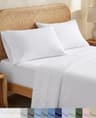
If a dog or cat shares your bed, buy cotton percale. Its tight, flat one-over-one-under weave breathes, gives hair no raised nap to catch in and gives claws no long floats to hook, and cotton takes frequent washing well. Avoid brushed surfaces such as flannel and brushed microfiber, which sleep warm, and sateen or waffle weaves, which snag.
Every other sheet page on this site assumes one person, or two, in the bed. This one is for the reader who has a third occupant with four legs, and who has noticed that the nights the dog or cat comes up are the nights they wake up hot. That reader has two problems the usual cooling advice never mentions. The animal is a heat source pressed against you for hours. And its hair and claws change which cooling fabrics are worth buying, because some of the weaves we normally recommend are exactly the ones a claw catches, and some of the fabrics sold as pet-friendly are exactly the ones a hot sleeper should avoid.
The animal is a second heat source
The Merck Veterinary Manual gives a normal rectal temperature of 99.5 to 102.5°F for a dog and 100.5 to 102.5°F for a cat. MedlinePlus puts normal human body temperature between 97 and 99°F. The two sets of figures are not measured the same way, so do not read the gap to the decimal, but the direction is plain: you are sharing the bed with a body that runs at least as warm as yours, lies against you for hours, and is wearing a fur coat.
No sheet removes that heat. What a sheet decides is whether the heat that builds up where the two of you touch can escape, and whether the sweat it produces is absorbed or left on your skin. That is the same job a sheet does for anyone, which is why the fabric rules below are the ordinary ones with two constraints added. It is also why the cheapest fix on this page is not a sheet at all, and we come to it before the picks.
What we required before a product could appear here
Every set we recommend below had to clear all four of these. The skip fails the second on purpose, and its write-up says why.
- The listing names the fiber. Cotton, linen, lyocell or polyester, in words, because the fiber decides what happens to sweat. A listing that only says cooling has told you nothing.
- The surface is not brushed, and no weave with long floats is stated. Those two constructions are where hair and claws cause the most trouble, as the next section explains.
- The listing says how to wash it. A bed with a pet in it gets washed more often than one without, so the care instructions are part of the product. One of the sets we would otherwise have considered does not state any in its feature bullets, and it is not here.
- It is currently purchasable. Every product was resolved from a live Amazon listing, and prices are pulled live rather than typed in by us. The method is on how we pick.
We did not require the words pet-friendly or pet hair resistant. Neither has a definition, and none of the three sets we recommend uses them in the feature bullets we read.
What decides a sheet for a bed with a pet in it
Rank sheets on these, in this order.
One: the surface, because hair, claws and heat all meet there. A dog-owner publication in our sources lists tightly woven cotton among the fabrics that are smooth and less prone to trapping fur, and names fleece, flannel and knits as the ones that trap it. Cotton Incorporated’s technical bulletin on napping explains why those fabrics feel the way they do: napping is a finishing process that raises fibers on the surface of the cloth, and napped fabrics such as flannel, moleskin and fleece have an “inherent warmth”. So the raised surface that catches hair is also the one that holds heat. A percale sheet has no nap at all, so hair lies on top of it rather than in it.
Claws are the second half of the surface question. Testex, a manufacturer of textile-testing instruments, sets out the two things that decide how easily a cloth snags: the longer the float in the weave, the easier a yarn is to snag and pull out, and the tighter the fabric, the more its yarns are held in place. A sateen weave floats four threads over one to get its sheen, which is the reason it sleeps warmer than percale on percale vs sateen and the reason a claw can lift a loop out of it. Percale is the opposite construction: every thread changes direction at every crossing, so there are no long floats on its face.
Two: the fiber, because the patch beside a warm animal gets damp. Cotton and lyocell take moisture into the fiber. Plain polyester does not, which is the argument set out on what wicking really means. That matters more here than on an ordinary bed, because the stretch of sheet between you and a warm animal is where sweat collects first.
Three: how it washes, because it will be washed a lot. Cotton percale is the robust one. Lyocell and viscose are regenerated cellulose, which is weaker when wet and asks for a gentle cycle, and that difference compounds when the sheets go through the machine more often than the usual week. The fabric-by-fabric routine is on how to wash cooling sheets, and every rule on it applies here.
Not on the list: thread count. A higher count means a denser cloth, which is the wrong direction for heat, and it tells you nothing about claws.
Where the usual cooling advice breaks down
Four fabrics this site recommends or discusses elsewhere behave differently once a pet is involved, and it is worth being plain about each.
- Waffle. The raised grid that makes a waffle blanket breathe is built from long floats, which are exactly what a claw catches, and the fabric table on our cooling sheets hub lists snagging first among cotton waffle’s weaknesses.
- Linen. It is a plain weave, so it has no long floats, but its value as a cooling fabric comes from an open, irregular cloth, and a looser cloth holds its yarns less firmly than a tight one. We would not call it claw-proof, and at its price we would not test the question on a dog that digs at the covers. If you want it anyway, the best linen sheets covers the sets.
- Sateen, including lyocell sateen. The cheapest pure-lyocell set we track now describes its weave as sateen in its listing, read September 17, 2026. That is the float weave claws catch, so it is not on this page.
- Microfiber. This is where the sources disagree with us, and the disagreement is honest. The same dog-owner list that recommends tightly woven cotton also lists microfiber and polyester among the smooth fabrics less prone to trapping fur. For hair alone, that may be right. For a hot sleeper it is the wrong trade, because polyester does not absorb sweat, and a brushed microfiber adds a raised nap that holds still air against you. The full case is on do microfiber sheets sleep hot.
The free fix: give the animal its own layer
Before you buy anything, change where the heat and the hair land. We are not going to tell you how to train a dog or a cat. We are only pointing out where the heat goes.
- Its own bed on the floor removes the heat source entirely. If the animal will take it, nothing else on this page matters as much.
- If it stays on the bed, put it on top of the covers, on its own washable throw. A layer between its body and yours is a layer its heat has to get through, and the throw takes most of the hair and most of the claw contact. It is also a much smaller thing to wash than a sheet set. This is the same logic as un-sharing the variables with a partner who runs a different temperature, set out on sleeping with a partner who runs a different temperature.
- Take the hair off before the wash, and skip the dryer sheet. The American Kennel Club suggests regular brushing to control shedding, and a lint brush, masking tape or a rubber squeegee to lift hair from furniture and clothing; use the same tools on the throw before it goes in the machine. It advises against dryer sheets: they cut static by coating fabric with cationic ingredients, fragrances and fabric softeners, and dogs lick the places they rest. The same coating cancels the absorbency you chose a cotton or lyocell sheet for, so on a cooling sheet it is a bad idea twice over.
- Think about what is under the sheet. A pet on the bed is one of the few risks that justifies a waterproof mattress protector, and every waterproof membrane costs you some breathability. If you need one, buy the thinnest that covers the risk, from the best mattress protectors for hot sleepers.
How to read the picks
Our best for a pet on the bed is an organic cotton percale set that the listing describes as a crisp, matte weave and, in its own words, “NOT a silky or smooth sateen weave”. That sentence is the whole reason it leads here: a listing that names the weave and rules out the float weave is telling you what a claw will meet. We read it as a heavier, longer-lasting cloth than the budget percales, which suits a bed that is washed often. The listing, read September 17, 2026, says to machine wash it warm and tumble dry low, and says the cloth is tested for shrinking, tearing and pilling, without saying by whom or to what standard, so treat that as the seller’s claim. Against it: it is mid-priced and costs more than the budget percales for the same fundamental weave, the heavier cloth takes longer to dry, it publishes no fabric weight, and today’s listing gives the fitted sheet’s limit as mattresses up to 15 inches deep, so measure the bed before you order. Percale is crisp and it wrinkles. And no woven sheet is claw-proof; a tight weave only gives a claw less to catch.
The cheapest set to rotate is the lowest-priced percale we track, and on this page it earns its place through arithmetic rather than spec. A bed with a pet in it needs changing more often, and two inexpensive sets of the right weave do more than one expensive set that is always in the wash. It names the percale weave in its title, its listing says machine wash warm and tumble dry low with no bleach, and it states a 16-inch fitted pocket. Its limitations are real: it is a thinner cloth than the pricier percales, which is worth weighing if your dog digs at the bed, and it publishes no thread count or fabric weight. Its listing also says the sheets “do not pill (for real)”, which is the seller’s promise rather than anything we can check. Buy it as the second set, or as the only set if the pet sleeps on its own throw.
The best if you wake up damp pick is a Tencel lyocell set, and it comes with a condition. Lyocell absorbs moisture into the fiber, which is the right property if the heat from the animal beside you turns into sweat, and its listing describes a silk-like surface rather than a brushed one. But three things count against it on this page. Its listing does not state a weave, so we cannot tell you what a claw will meet. Lyocell drapes flat against your skin rather than standing off it, so it moves less air than percale. And it wants gentle treatment: the listing says a gentle cycle, cold or warm, and tumble dry low, which is a real cost on sheets that get washed often. Buy it only if the animal sleeps on its own throw on top of the covers, so the claws never reach the sheet. It is mid-priced.
The skip is brushed polyester microfiber, the kind of fabric some pet-hair advice recommends. Hair may well slide off it. Heat does not. The listing states 100% polyester and a brushed finish, and brushing raises fiber ends on the surface, the same kind of raised surface that gives flannel and fleece their warmth. Polyester does not absorb sweat, so the damp patch beside a warm animal stays damp. It is the cheapest set on the page, it does not wrinkle, and on a guest bed or in a cold room it is perfectly sensible. For a hot sleeper with a dog against their legs, it solves the smaller problem and makes the bigger one worse.
What these listings publish
Fiber and weave from each product's recorded listing; wash instructions and fitted pocket as today's listings state them, read September 17, 2026. Our read of published construction, not a wear test. | Fiber | Weave, as stated | Wash, as stated | Fitted pocket | Price band |
|---|
| Best for a pet on the bed | 100% organic cotton | Percale | Warm, tumble dry low | Up to 15 in | Mid |
| Cheapest set to rotate | 100% organic cotton | Percale | Warm, tumble dry low, no bleach | 16 in | Budget |
| Best if you wake up damp | Tencel lyocell | Not published | Gentle, cold or warm, tumble dry low | 16 in | Mid |
| Skip this | Brushed polyester microfiber | Not published | Machine washable, dryer safe | 14 in | Budget |
None of the three we recommend prints a fabric weight, the one figure that would tell you how much cloth stands between a claw and a hole. That is why the weave carries so much weight on this page: it is the construction fact a listing actually gives you.
If the bed is still too hot
Then the sheet was not the limit. Try one week with the animal on its own bed, off yours, as a test. If you sleep cool, you have your answer, and the question becomes a household one rather than a bedding one. If you are still hot, the heat is coming from the room, the top layer or the mattress, and the order to check them in is on what to fix first. The wider ranking of sheets, without the pet constraints, is on our cooling sheets roundup.