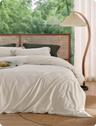
“Bamboo” in bedding means viscose or rayon regenerated from bamboo pulp, and the useful thing it does is absorb moisture into the fiber rather than holding it on the surface. That makes a bamboo blanket the right choice if you wake up damp. If you wake up hot and dry, an open weave in cotton will do more, because viscose does not move much air.
Start with the label, because it tells you something about the seller. The FTC’s textile guidance requires these fabrics to be called rayon, or viscose derived from bamboo, rather than simply “bamboo” — none of the plant’s structure survives the chemical regeneration that produces the fiber. Every pick on this page names the fiber correctly on its own listing. It is a small signal and a real one.
Prices on the buttons below are live, read as of November 22, 2026.
What viscose does, and what it does not
Viscose is regenerated cellulose. It is absorbent, it drapes smoothly, and it feels cool on first contact because a smooth dense fabric conducts heat out of your skin faster than a textured one does. Those three properties sell a lot of bedding, and only the first is doing durable work overnight.
The cool first touch is conduction, and it equalises within a minute or two of you lying still — the physics of it, and why “Q-Max” numbers on a listing describe the first ten seconds rather than the night, is on Q-Max cooling ratings. The absorbency is the property that lasts, because sweat has to go somewhere and a fiber that takes it up is better than a fiber that lets it pool against you.
What viscose does not do is move air. A smooth, densely draping blanket sits against you. If your problem is a stuffy, still bedroom rather than sweat, the structure of the cloth matters more than its fiber, and a waffle weave or a muslin gauze is the better object. The comparison across all the fiber options is on cooling blanket materials.
The picks
JSELF 100% viscose from bamboo quilt— our overall pick. It is a quilted lightweight all-season blanket, so the shell fiber is the absorbent one and the quilting keeps the fill from lofting into an insulating layer. That combination — absorbent face, suppressed loft — is the most useful thing you can put over a person with night sweats.
Bedsure cooling waffle-weave blanket, cotton and bamboo rayon— the budget pick and arguably the cleverest construction here, because it is the only pick that gets both mechanisms: the bamboo rayon absorbs, and the waffle structure holds the cloth off your skin so air can move through it. It is the blanket we would put on a bed for a whole summer in place of a comforter.
Bedsure PureWoven 100% viscose from bamboo duvet cover— for anyone who is not replacing their duvet, only what goes around it. The cover is the layer against your skin all night, so changing it is the cheapest way to change what a bed feels like. Its listing states OEKO-TEX STANDARD 100, which is the only certification stated by anything on this page. The rest of the field is on cooling duvet covers.
The one to skip, and why
The PHF double-sided blanket pairs rayon from bamboo on one face with an Arc-Chill cold-touch fabric rated Q-Max greater than 0.4 on the other, and it is our skip here for the same reason it is our skip on the quilts page. A cold-touch face is a conduction trick: it feels dramatic for the first few seconds and then equalises with your skin, at which point you are sleeping under the thermal properties of the rest of the blanket. Pay for the fiber and the structure, not for the first ten seconds. It is not a defective product — it is a product whose headline feature does the least durable work.
What each listing states. Mechanism is our read of the published construction, not a measurement.| Blanket | Fiber as labelled | Structure | Mechanism | Certifications stated |
|---|
| JSELF quilt | 100% viscose from bamboo shell | Quilted, lightweight | Wicking | None stated |
| Bedsure waffle | Cotton and rayon from bamboo | Waffle weave | Airflow | None stated |
| Bedsure duvet cover | 100% viscose from bamboo | Twill | Wicking | OEKO-TEX STANDARD 100 |
| PHF double-sided (skip) | Rayon from bamboo and Arc-Chill face | Quilted, double-sided | Cold-touch conduction | None stated |
Care, because viscose is the fussy one
Viscose is at its weakest when wet. Wash cold, skip the hot dryer, and do not wring it. That is not a minor footnote on a blanket you bought because you sweat into your bedding — it is the single thing that decides whether you still own it in two years. The full routine is on washing a cooling blanket.
If night sweats rather than general heat are the reason you are on this page, the whole-bed version of the answer — sheet, top layer and cover together — is on blankets for night sweats.
If you’re drenched most nights, or it started suddenly, that’s worth raising with a doctor — it’s outside what bedding can fix, and outside what we cover.