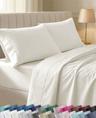
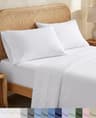
Sateen is a weave, not a fiber: four warp threads float over one weft, which is what produces the sheen and the smooth hand. Those long floats also lie flatter against your skin and leave less open area between yarns than percale does, so sateen is the warmer of the two standard cotton weaves. Buy it for feel. Our pick is the California Design Den 100% cotton sateen at 400 thread count; the budget pick is the LANE LINEN 450 thread count sateen. If heat is the actual problem, buy percale instead — the same brand makes one. Prices are read live as of November 22, 2026.
Almost every sheet listing on every marketplace sells you a fiber and a number. Hardly any of them sell you the weave, which is a shame, because the weave is the part you feel first and the part that decides how the set behaves on a hot night. Sateen is one of the two weaves worth knowing, and it is the one that is nearly always sold without being named.
What sateen actually is
A woven fabric is just threads crossing threads, and the pattern of the crossing has a name. In percale the pattern is one over, one under, repeated: the loosest, most open structure in common use. In sateen the pattern is four over, one under, so each warp thread floats across four weft threads before it dips. Those floats are why sateen looks faintly lustrous, why it feels slippery rather than crisp, and why it drapes instead of standing away from the mattress.
Everything good about sateen follows from the floats. So does the one thing against it: a surface made mostly of long floats is a flatter, denser surface with less air in it. Heat leaves your body through still air, and sateen holds less still air at the surface and lies in closer contact with your skin. That is not a marketing claim anyone has to prove or disprove — it is what the geometry of the weave does.
We set the two side by side in detail on percale versus sateen. The short version: percale sleeps cooler, sateen feels softer, and both statements are true at the same time.
Why thread count climbs in sateen, and why it still doesn’t help
Notice that two of the sets on this page publish higher thread counts than almost anything on our percale page. That is not a coincidence and it is not an upgrade. A four-over-one float structure can pack more threads into the same square inch than a one-over-one structure can, so sateen listings get to print a bigger number. The number describes density. Density is the opposite of what a hot sleeper wants.
This is the single most expensive misunderstanding in the sheet aisle: people pay a premium for a higher thread count, receive a denser fabric, and sleep hotter than they did on the cheap set they replaced. The full argument, with the figures listings do and don’t publish, is on thread count and cooling.
The criteria, in the order that matters
1. Is it actually cotton? The sateen feel is cheap to imitate in polyester, and the marketplace imitates it constantly. Cotton absorbs sweat into the fiber; polyester carries it on the surface and hands it back to you. Every keeper on this page is 100% cotton or 100% lyocell. Nothing here is a blend.
2. Does the listing name the weave?A set that says “sateen” on the front has told you the one fact that predicts how it will feel. A set that says “silky smooth” and nothing else is hoping you will not ask. All four keepers name their weave.
3. Staple length, where the listing states it.Longer cotton staples spin into smoother, stronger yarn with fewer loose ends, which means less pilling over years of washing. “Egyptian cotton” is a claim about staple length and origin, not about temperature — worth paying for if you want the set to last, worth nothing if you bought it to sleep cooler. We take that apart on Egyptian cotton and heat.
4. A certification you can look up.Three of the four keepers state OEKO-TEX certification, which is a chemical-residue standard rather than a performance one — it tells you what is notin the fabric. That is a real thing to know about something you breathe against for eight hours, and the certificate number is checkable on OEKO-TEX’s own label-check tool.
What is not a criterion:thread count, as above. Also the words “cooling”, “luxury” and “hotel”, none of which is defined, and none of the figures we would actually want. Not one listing on this page publishes a GSM, which is the only number that would let you compare fabric weight across brands. Our product tables say “Not published” because that is the truth.
The picks
California Design Den 100% cotton sateen, 400 thread count— the pick. Pure cotton, weave named, thread count published, OEKO-TEX stated, 16-inch pocket so it fits a deep mattress with a topper on it. What makes it the pick rather than merely adequate is a quirk of our registry: the same brand’s percale set is also here, at a similar price, in the same fiber. If you buy this and decide in August that you want the cooler weave, you can switch and change exactly one variable. Honest cons: 400 threads in sateen is a dense surface, and no GSM is published.
LANE LINEN 450 thread count 100% cotton sateen— the budget pick, and the cheapest correctly labeled cotton sateen we know of. Same fiber, same weave, same OEKO-TEX claim, 15-inch pocket. The 450 figure is higher than our top pick’s 400 and we treat that as a mild negative, not a feature. Buy this one to find out whether sateen is for you; it is cheap enough that the answer “no” costs very little.
Threadmill 400 thread count Egyptian cotton sateen— the pick if you want the fabric to still be good in five years. Long-staple Egyptian cotton, weave named, thread count published, OEKO-TEX stated, all-around elastic and a 16-inch pocket. It is the most expensive set here and the fiber length is the reason, not the temperature.
Weddingly 100% Tencel lyocell, sateen weave— the sateen that isn’t cotton, and a genuinely interesting option. Lyocell moves moisture faster than cotton does, so a lyocell sateen gets you closer to having both things at once: the surface you wanted and better sweat handling than cotton sateen manages. It is still the warmest-sleeping set on our lyocell roundupfor exactly the reason this page exists, and the listing’s certification claims name no standard, so we leave its certifications empty.
California Design Den organic cotton percale— not a sateen, and on this page deliberately. If you arrived here because you are hot at night rather than because you love the way sateen feels, this is the set to buy instead: same brand, same fiber, the open weave. Putting it in the picks is the most useful thing this page can do.
Amazon Basics brushed microfiber — skip this.It is what the marketplace offers when you search for a smooth, silky, cheap sheet, and it is polyester. Brushing the surface produces a hand that reads as “soft” in a photograph and behaves like a plastic bag at 3am: the fiber does not absorb moisture, so your sweat stays between you and the sheet. Microfiber and heat gets its own page because the mistake is so common — why microfiber sleeps hot.
Every figure as the listing publishes it. 'Not published' means the listing states no figure — which is true of GSM on all six.| Set | Fiber | Weave | Thread count | Certification stated | GSM |
|---|
| California Design Den sateen | 100% cotton | Sateen | 400 | OEKO-TEX | Not published |
| LANE LINEN sateen | 100% cotton | Sateen | 450 | OEKO-TEX | Not published |
| Threadmill Egyptian sateen | 100% Egyptian cotton | Sateen | 400 | OEKO-TEX | Not published |
| Weddingly lyocell sateen | 100% Tencel lyocell | Sateen | Not published | None named | Not published |
| California Design Den percale | 100% organic cotton | Percale | Not published | None named | Not published |
| Amazon Basics microfiber (skip) | Brushed polyester | Not published | Not published | None named | Not published |
Read that table across the Weave column, not down the Thread count column. The four sateen sets differ from each other in fiber and price; they do not differ in the thing that decides how warm they sleep, because that thing is the same weave in all four.
Satin is not sateen
Worth 30 seconds, because the two words are one letter apart and the products are not related. Sateen is a weave structure applied to a staple fiber, usually cotton. Satinis the same float structure applied to a filament fiber — historically silk, today almost always polyester. A “satin” sheet or pillowcase at a marketplace price is polyester, and it behaves like polyester: cool to the first touch, then damp. Our registry carries a polyester satin pillowcase and recommends it for hair, not for heat. The distinction is drawn out on silk versus cooling sheets.
Washing sateen without losing the sheen
Sateen’s long floats are its weak point mechanically: a snagged float pulls a line across the surface, and that is the damage you will actually see. Wash warm or cool rather than hot, keep zips and velcro out of the load, skip fabric softener (it coats the fiber and dulls the sheen it is sold to improve), and take the set out of the dryer while it is still faintly damp. Sateen wrinkles less than percale, so the reward for doing this is immediate. The full routine is on caring for cooling sheets, and the pilling question specifically is on wrinkles and pilling.
How we picked these
Fiber first, weave named second, thread count treated as information rather than as a score — the method is on how we pick. We have not slept on these sets, laundered them or measured them, and we never claim to have. Each listing was read on the date stamped in its product table and confirmed as a live, in-stock offer before we featured it. Every figure above is either stated on the listing or marked “Not published”. Prices come from the live layer at render time rather than from anything typed into this page.